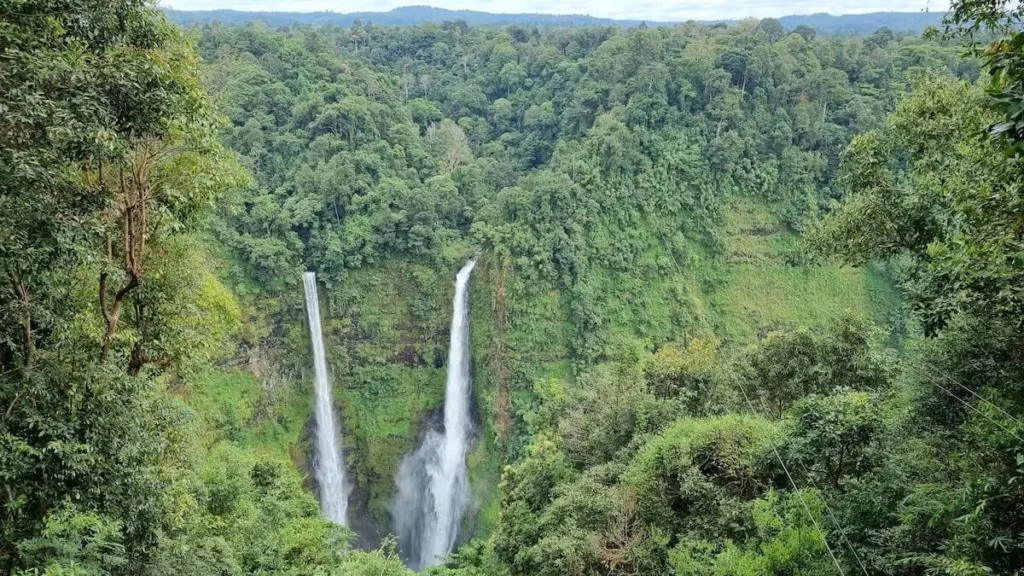
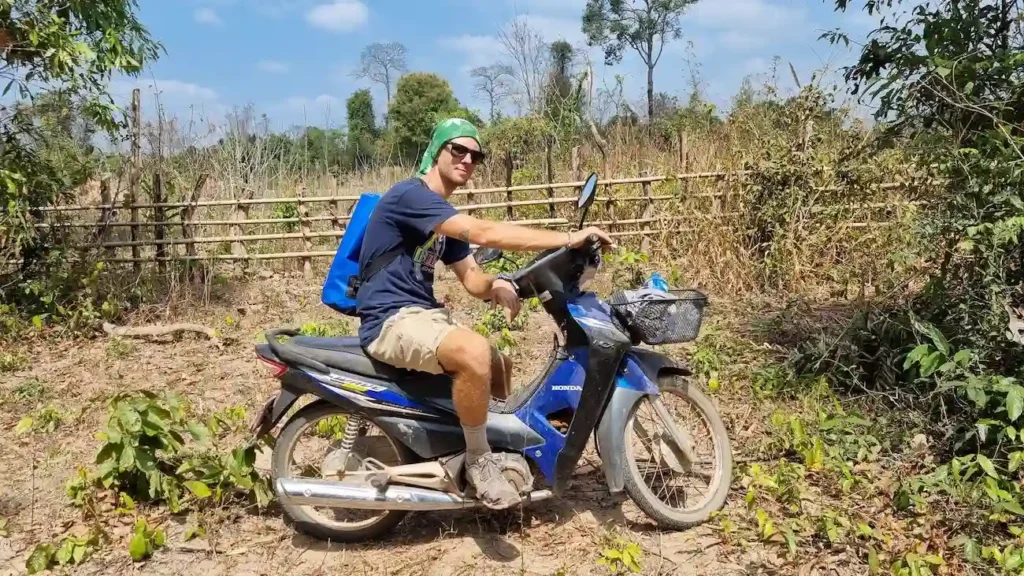

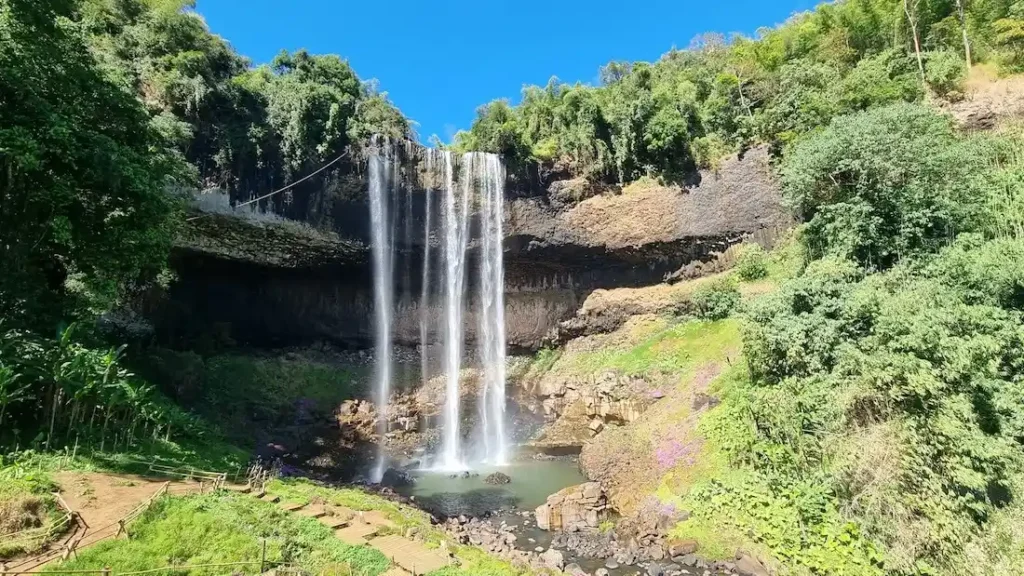
Welcome to the most detailed guide to the Tad Tayicseua Waterfall Valley in Champasak Province, Southern Laos. Tad Tayicseua is often wrongly described as a single waterfall, but in reality it is an entire waterfall valley made up of seven different waterfalls, all connected by hiking trails through lush jungle scenery. The most popular and picturesque waterfall is Tad Jarou Halang, which you will find on many blogs. Because of its remote location, many travelers riding the Bolaven Plateau motorbike loop skip Tad Tayicseua. Some only visit it as a detour on the so-called Big Bolaven Plateau Loop. Would I recommend the detour? Absolutely yes. Tad Tayicseua valley is one of the most impressive and underrated natural attractions in southern Laos, so better don’t miss it! It feels like the waterfall capital the Lao PDR.
In this guide, you’ll find everything you need to know: how to get there, where to stay, detailed information about all seven waterfalls, trail and road conditions, and practical visiting tips. As a highlight, we’ve created a 360-degree aerial drone tour of the entire Tad Tayicseua valley, offering a unique perspective and making it easier than ever to explore and navigate this stunning area.
To reach the Tad Tayicseua Waterfall Valley, a small detour from the Bolaven Plateau loop is required. The valley lies in a remote and less-visited part of the Bolaven Plateau, at elevations of around 1,300 meters above sea level, surrounded by dense forest and coffee plantations.
Most travelers approach Tad Tayicseua either from Paksong in Champasak Province or from Sekong Province, depending on their route. Is is important to mention, that the last part of the road is a dirt road, which continues for about 5km. The standard Google Maps locations are not reliable and you will end up in the middle of nowhere. We drove the road ourselves, asked our way from locals and marked everything in the map below.
🏍️ From Paksong:
If you are coming from Paksong, take road 16E at the intersection with road 16. Road No. 16 would lead towards Thateng, which would be part of the small loop, but in our case we want to continue the route for the big loop. Following route 16E, riding past the popular Bolaven Cafe and beautiful coffee plantations, simply follow the road. If you want to take a rest, there is a bigger town called Houay Kong, with some guesthouses and homestay’s. Keep going until you pass Tad Khoo Waterfall. Stop there if you want or keep following the road until Intersection 3 (marked on the map). Turn left and follow the dirt road until you reach the last Intersection 4 (also marked on the map below). At this last intersection turn right (if coming from Paksong) and continue a few hundred meters until you reach the parking lot of Tad Tayicseua.
🏍️ From Sekong:
If you come from the direction of Sekong town, you probably doing the whole big loop. From Sekong it’s quite easy to use GPS and Google Maps towards the waterfalls Tad Faek and Tad Hua Khon. We visited both and as of January 2026, there wasn’t much because they’re building the site for tourists. Lot of construction was going on there. Keep going until Intersection 1 (marked on the map), close to Thuy Dung Motel 2. Turn right and follow the GPS until a waterfall called Tad Xekatam. We didn’t stop there as there is usually not much water during dry season. We saw a small walking path down to the waterfall right from the main road. No parking or anything available there though. Follow the road until you pass the Xekatam 1 Xenamnoy 2 Hydropower Plant. Keep going til Intersection to, which leads to a dirt road. Now you continue for about 5km on this dirt road. This part of the road should only be ridden by experienced riders because it’s steep, unpaved and adventurous. Keep going on that dirt road until you pass through another village and finally cross a bridge (both locations marked on maps). Soon you reach the last Intersection and turn left. Then it’s just a couple of hundred meters to Tad Tayicseua parking and entrance.
Road conditions to the Tad Tayicseua Waterfall Valley vary depending on the direction you approach from and the season. While the area is remote, access is generally possible for motorbikes and standard 2WD vehicles in dry conditions. During wet/rainy season in Laos, I would recommend at least a semi-automatic bike, dirt-bike or 4×4 / AWD car.
From Paksong, most of the route follows paved plateau roads that pass through coffee plantations and small villages. The final kilometers are narrower and may include patchy asphalt, concrete sections, and short gravel stretches. During the dry season, the road is usually in good condition, but loose gravel and potholes can appear after heavy traffic or rain.
Approaching from Sekong involves quieter rural roads with less traffic and fewer services. While much of the route is paved, maintenance can be inconsistent, and some sections may feel more isolated. After rainfall, certain parts can become muddy or slippery, especially near forested areas.
Roads were generally quite ok for lao standards, with occasional potholes as always, but that’s quite normal. The last stretch on the dirt road near Tad Xekatam is quite an adventure ride. Motorbiking in Laos can be super fun, but make sure to have some experience riding on dirt roads with deep holes and kilometers of nothing but sand, gravel and deep potholes.
Once you arrive at the area of Tad Tayicseua you will find a large parking lot for enough space to park your motorbike or car. Car and motorbike parking was free, only the entrance fee needs to be paid. If you decide to stay at Tad Tayicseua Homestay, you can also drive your car all the way inside. Motorbikes can ride further after the barrier and park inside anyway, even if you don’t stay at the Homestay.
➡️ Entrance Fee: Foreigners have to pay an entrance fee of 55.000 LAK (2,60 USD) and Laotians 45.000 LAK (2 USD), which is ridiculously cheap for such a hidden gem! I liked the fact, that foreigners pay only slightly more. Not like in Thai national parks, where dual pricing scams still exist and foreigners pay up to 10 times the price than a local person!
Entrance fees are usually paid in cash, so it’s good to have some small bills with you. If you’re unsure how cash payments, prices, or daily expenses work in Laos, this article on using money in Laos explains it in more detail.
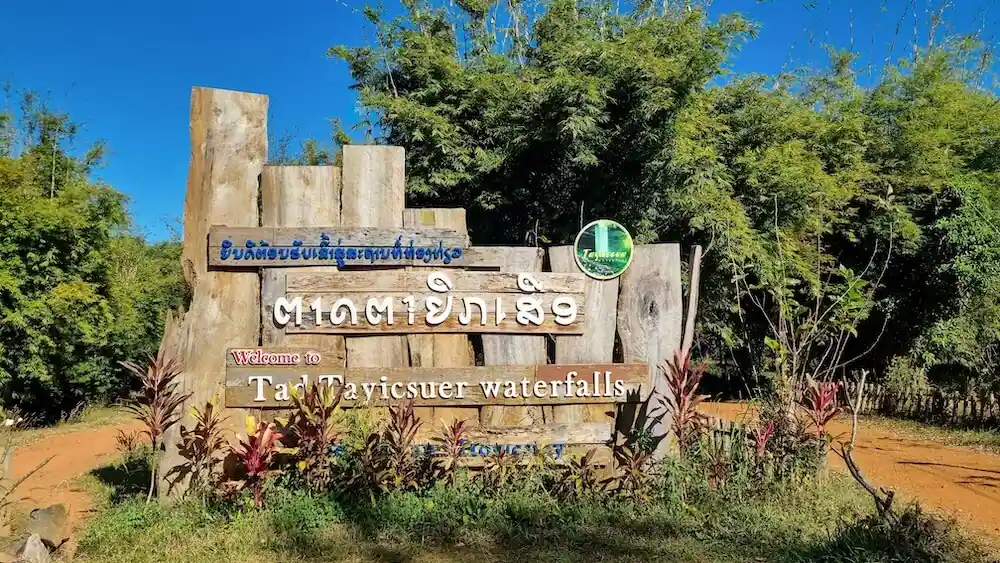
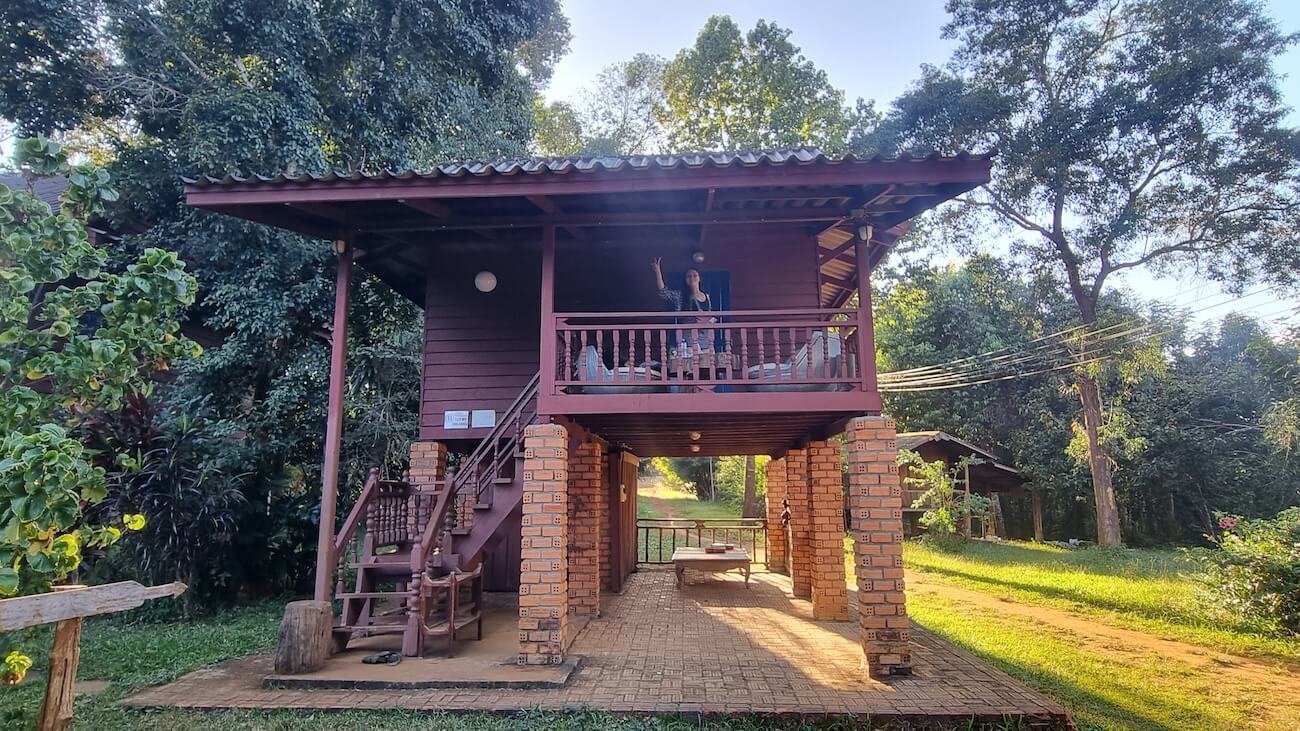
Right in the heart of the Tad Tayicsuea waterfall valley, there is one simple but well-located accommodation option. I would definitely recommend spend the night there because there is so much to explore. You have the choice between 3 types of accommodation available:
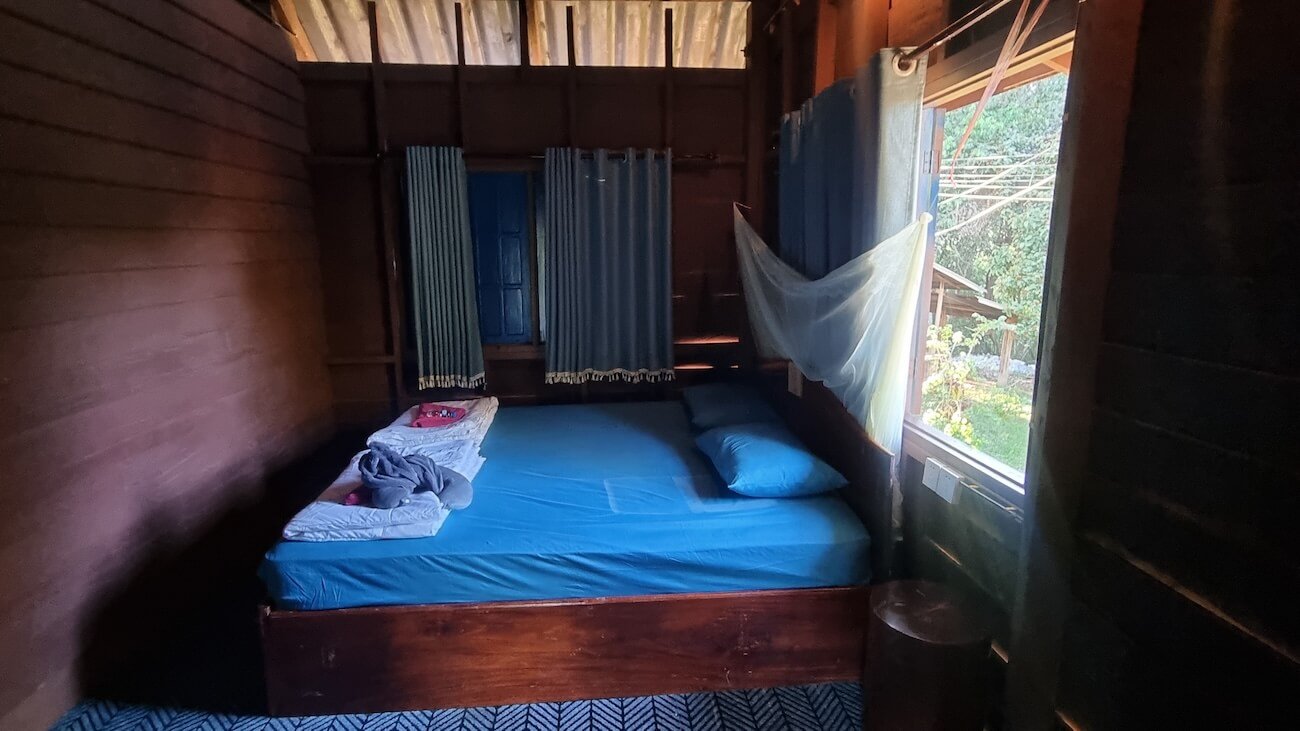
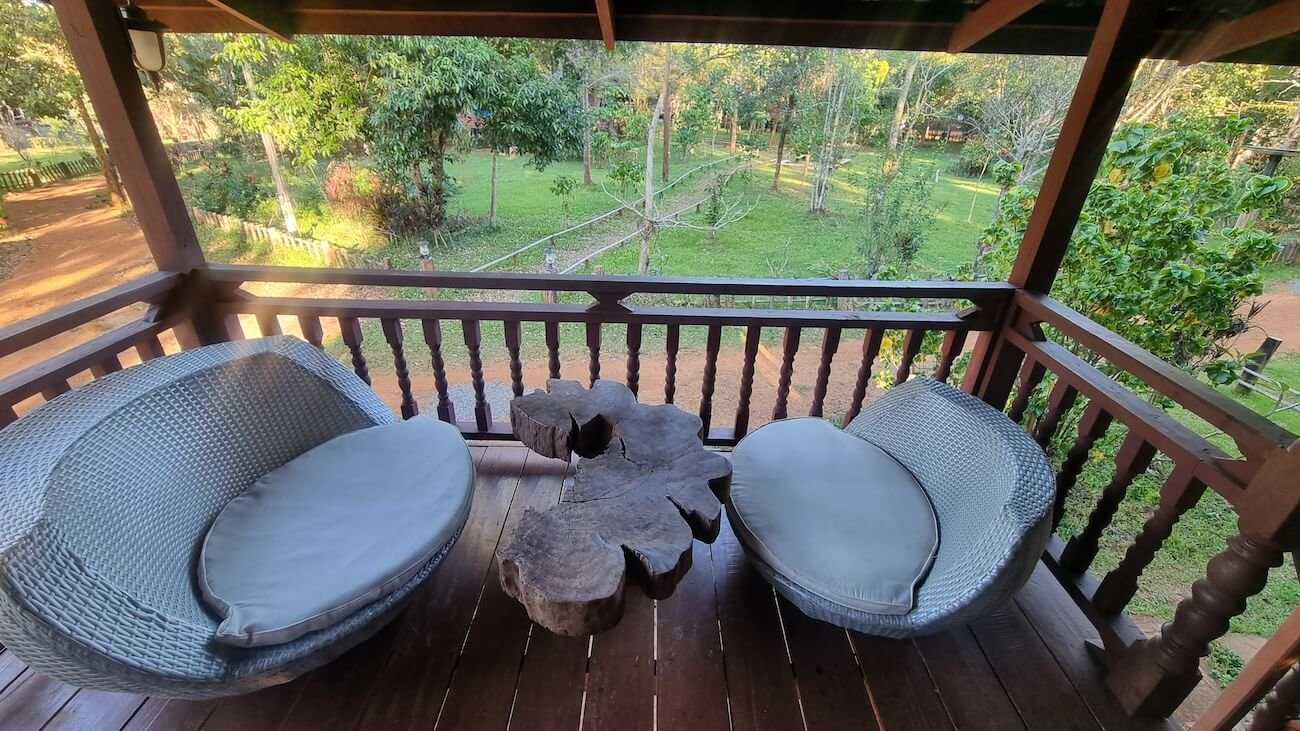
➡️ Bungalows with double bed: Perfect for couples. A simple bungalow with small balcony and attached bathroom equipped with private western toilet and hot shower. Price is 390.000 LAK per night (18 USD).
➡️ Big Dormitory/Family Bungalow: This is a great option for groups up to 6 people. The big bungalows have 2 rooms with 3 single beds in each room and is equipped with 2 bathrooms, western toilet and hot water. Price is 150.000 LAK / person per night (7 USD).
➡️ Tents: When we were there, they only had normal couple tents available, obviously with shared bathroom for 150.000 LAK per night (7 USD). You can probably also bring your own tent if you have one.
There is one restaurant on site, run by the same owner as the homestay. We had both dinner and breakfast there. The food was very basic and average, but the coffee was excellent, which makes sense given the location on the Bolaven Plateau. Don’t expect much in terms of food variety or quality – this is very much a remote, rural setup.
A small mini mart next to the restaurant sells snacks, beer, water, instant noodles, and basic supplies. Both the restaurant and mini mart close around 9:00 PM, so make sure to stock up in advance. The restaurant reopens at 7:00 AM.
We stayed here on Christmas Eve 2025, and apart from us, there were only three other guests. We set up our own campfire, had a couple of Christmas beers, enjoyed the quiet surroundings, and spent the evening under a clear, star-filled sky.
Spending the night here truly felt like staying in a “million-star hotel”, surrounded by nature and far away from any noise or crowds – a magical and memorable experience. So better don’t rush and spend the night there to explore. After a quiet night, the next morning we headed out to the hiking trail and discover the valley of seven waterfalls ourselves.
Short answer: Yes – if you want to truly experience the valley.
Staying overnight at Tad Tayicseua allows you to explore the waterfall valley without time pressure. Early mornings and late afternoons are the best moments to visit the waterfalls, when the light is softer, the valley is quiet, and most day visitors are gone.
An overnight stay is especially worth it if you:
However, this place is NOT ideal if you:
As it is common to NOT pre-book hotels & guesthouses in Laos online, also the Tayicseua Homestay can even not be pre-booked online. Just go there and even in high-season it’s very likely that they are not full because the area is not much visited as other parts on the Bolaven Plateau. Pakse will be the starting point of both, the big and small loop. If you really feel like you need to book your accommodation online, you can do so in Pakse and check options on Agoda. Otherwise just go with the flow and check prices when arriving at the accommodation.
As mentioned in the beginning, Tad Tayicseua is not only one waterfall, it’s a valley surrounded by seven waterfalls. Here is a list of all the waterfalls you can explore. The list is also in order in which you find the waterfalls on the trail.
Exploring the Tad Tayicseua Waterfall Valley is primarily done on foot. A natural jungle hiking trail connects the seven waterfalls and allows visitors to experience the valley at a slow and immersive pace. The trails lead through dense forest along river sections, making the hike an essential part of the Tad Tayicseua experience rather than just a way to get from one waterfall to another. The first section of the trail is well marked, but then it gets a bit trickier as signs are partly gone and jungle getting thicker.
Tad Kiet Ork Waterfall is the closest waterfall to the café and restaurant. There is a viewing platform right next to the restaurant, from where you can see the waterfall from a distance. A well-maintained staircase leads down to the impressive Tad Kiet Ork Waterfall. It takes approximately 10–15 minutes to descend the stairs. Once you arrive at the waterfall, you can stand right in front of it, which is perfect for taking photos.
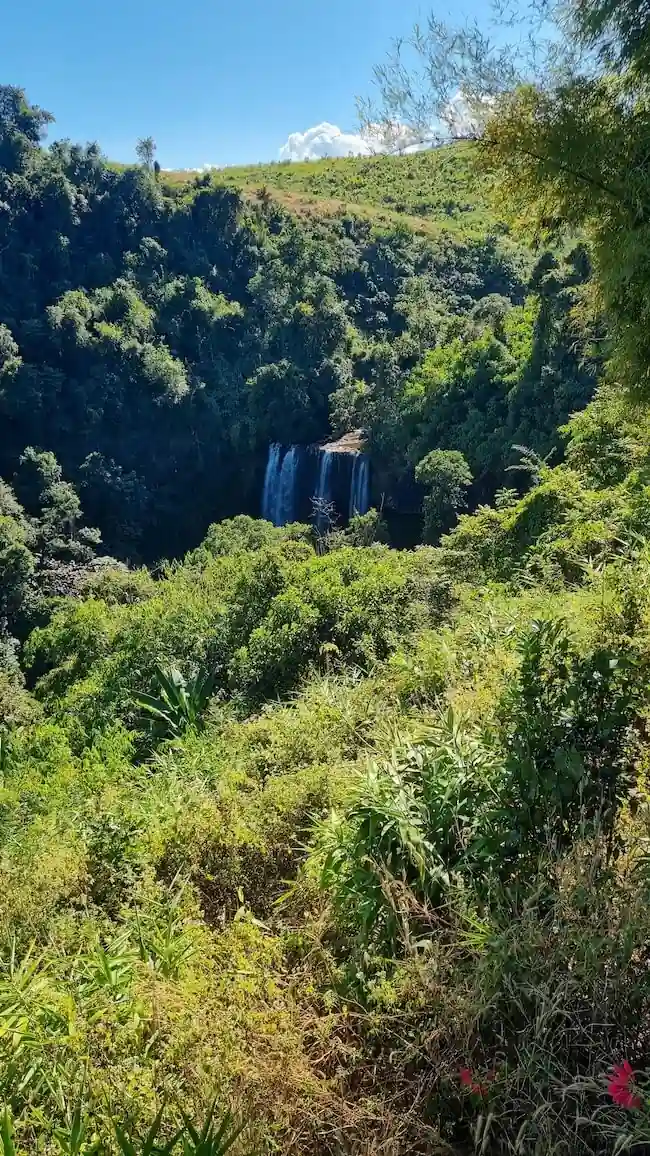
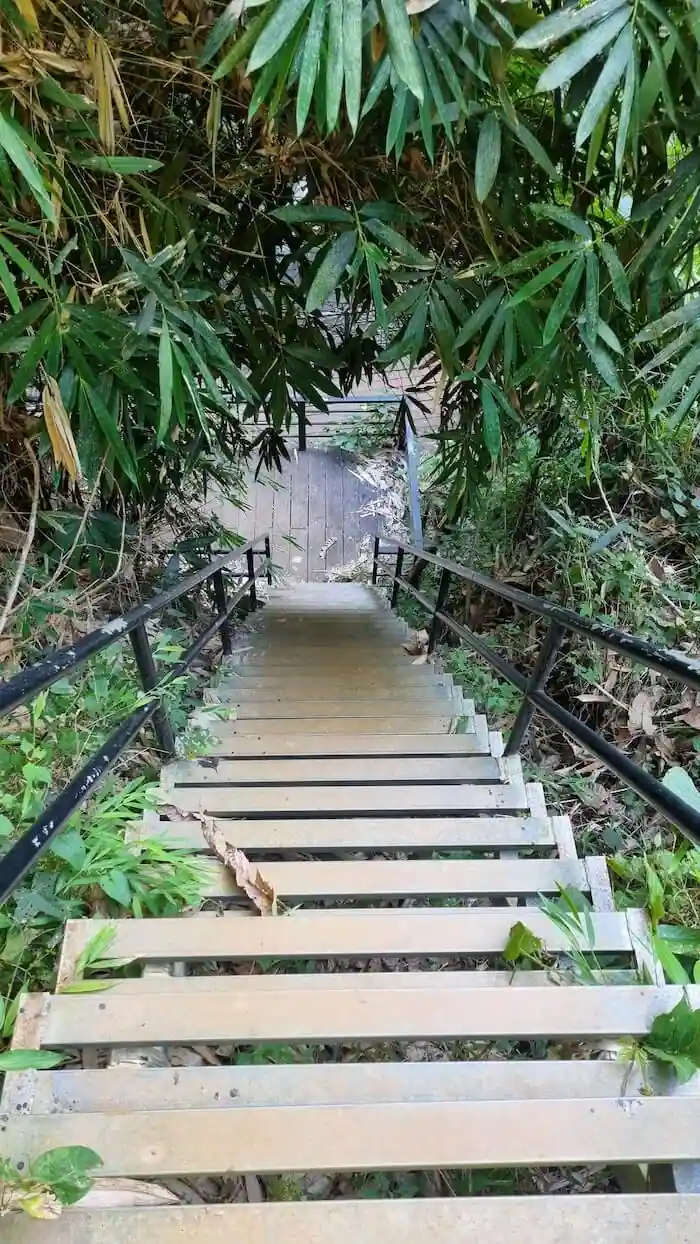
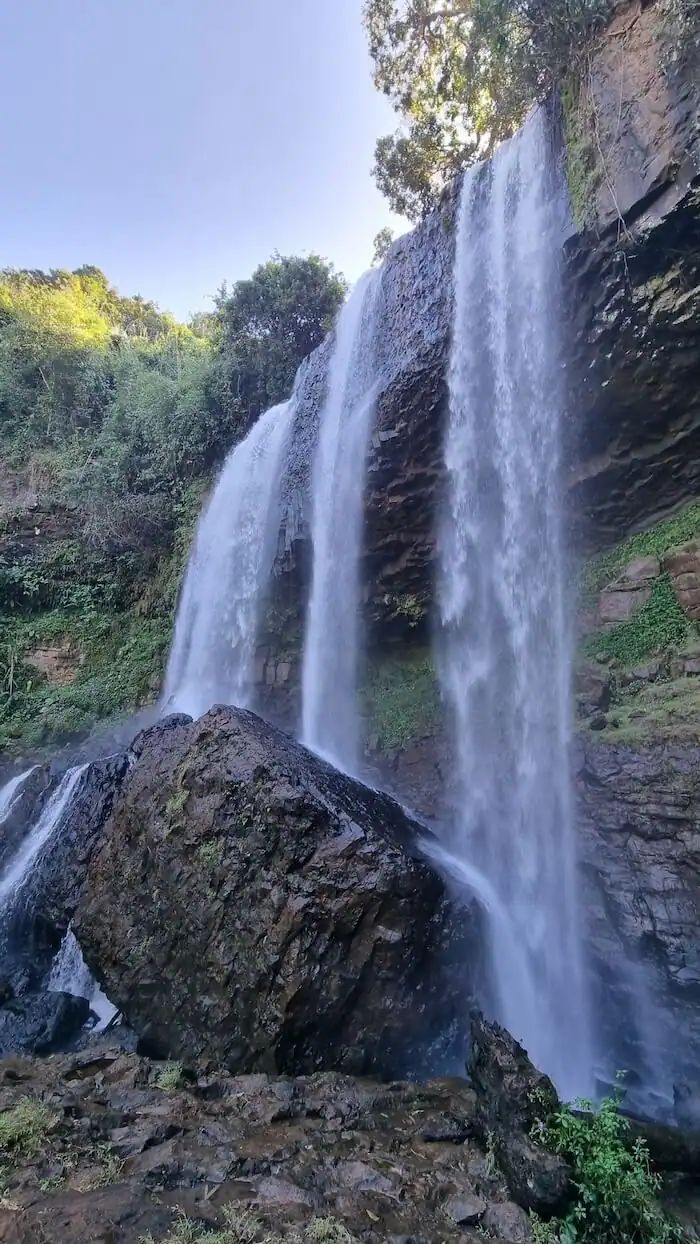
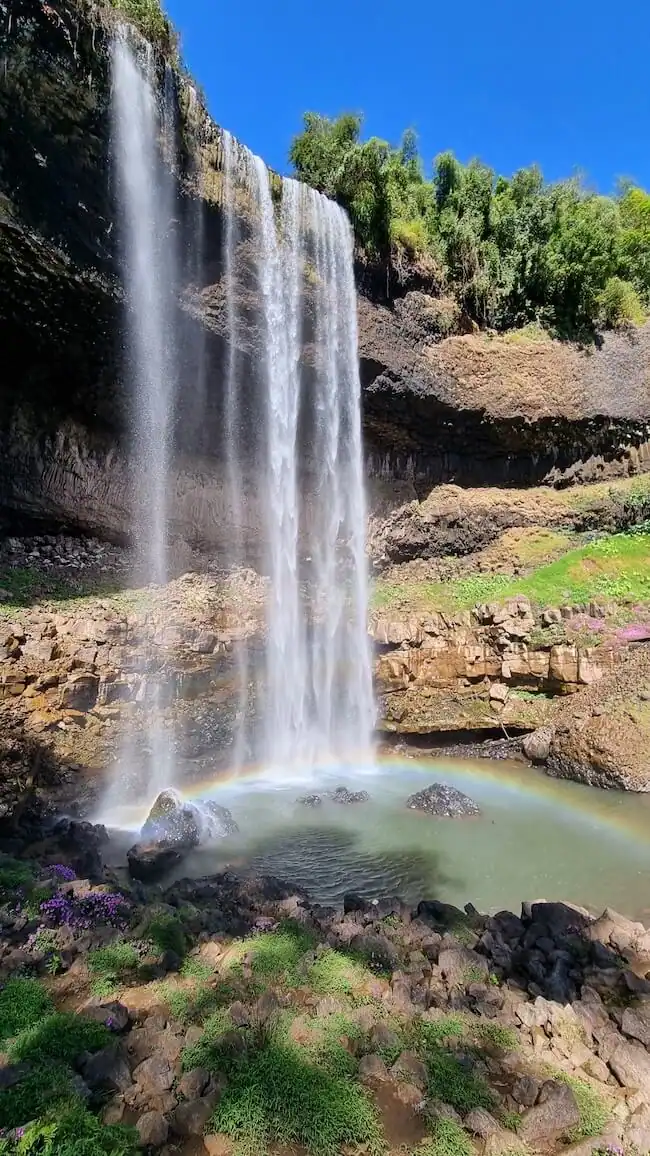
Without a doubt, Tad Jarou Halang is the most popular and also the most picturesque waterfall in the valley. We visited it in the late morning, when the light was perfect. It is also quite common to see a rainbow forming in front of the waterfall, adding to its visual appeal. Several viewing platforms allow you to take photos from different angles. At the right time of year, the area around the waterfall is filled with blooming pink flowers, creating a beautiful natural backdrop.
The fact that Tad Jarou Halang can be reached via a short 20-minute walk and is set in such a scenic natural environment makes it the most popular waterfall among visitors. Most of the people we met there were Thai or Lao travelers, and we saw very few Western tourists.
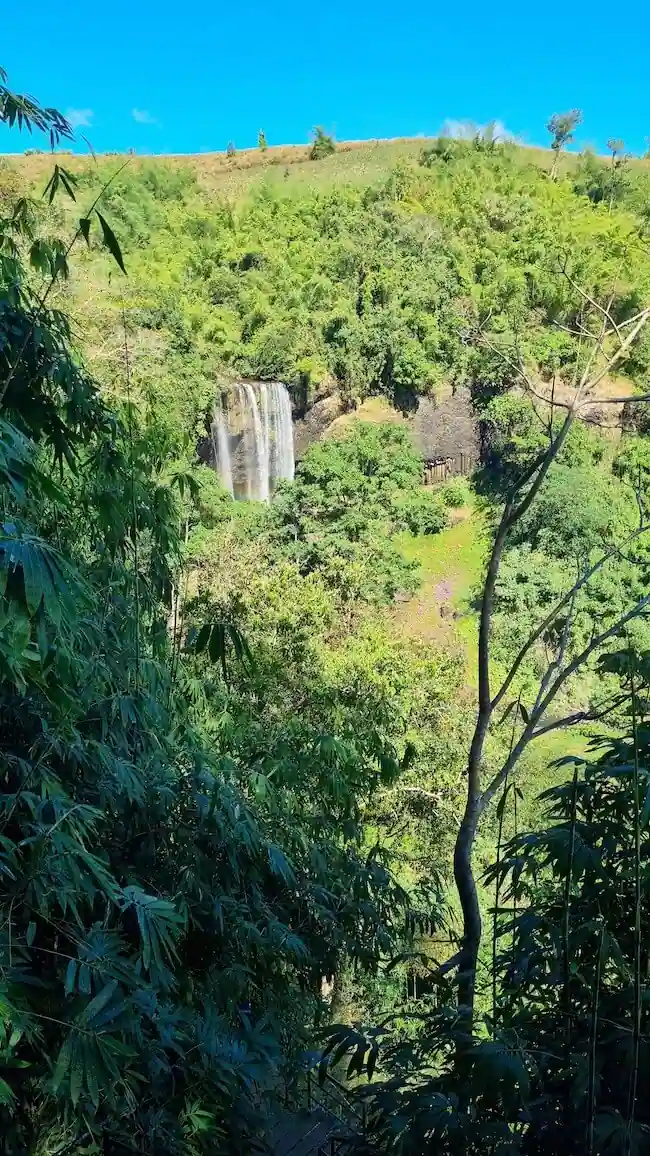
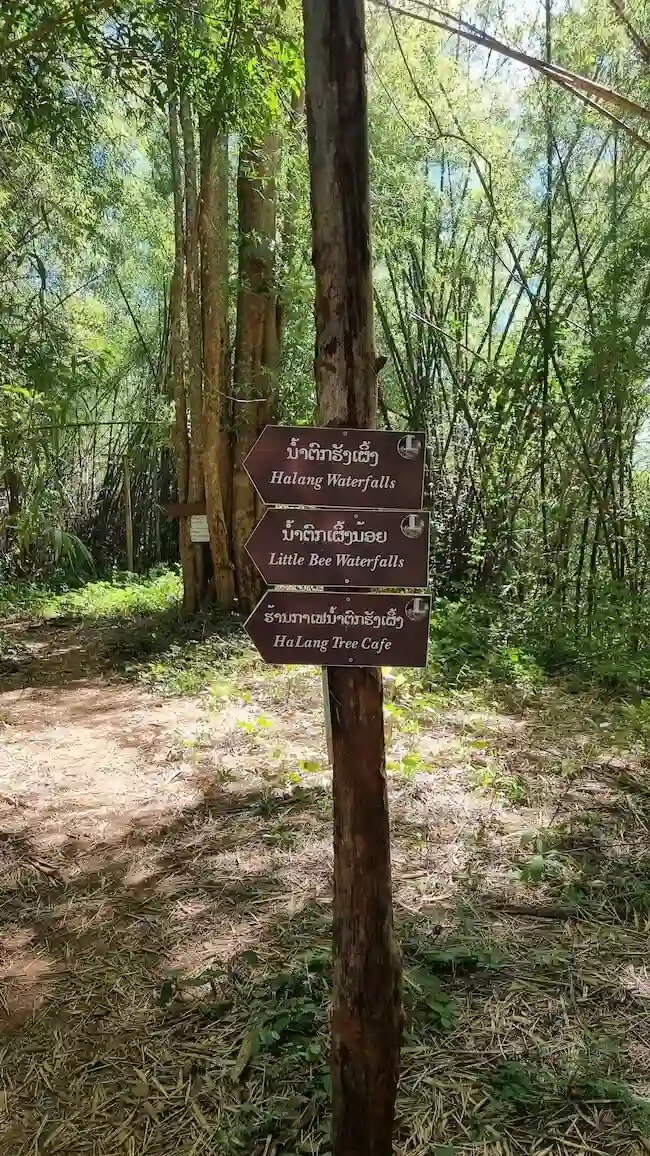
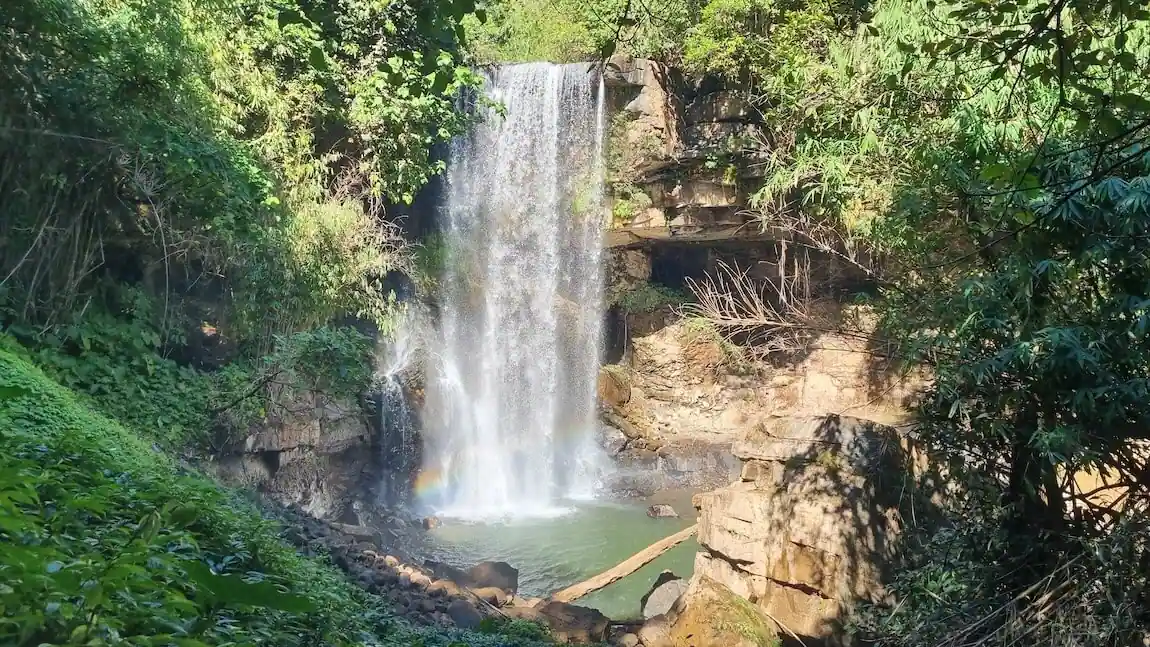
This is where the jungle trail begins. From Tad Jarou Halang, there are well-marked signs showing the direction to Little Bee Waterfall. It is just a short walk through coffee plantations, jungle, and river sections to reach the waterfall. Crossing an adventurous Lao-style bamboo bridge along the path will make you feel like an explorer. It is not possible to swim at Little Bee Waterfall, but it is ideal for a quick photo stop.
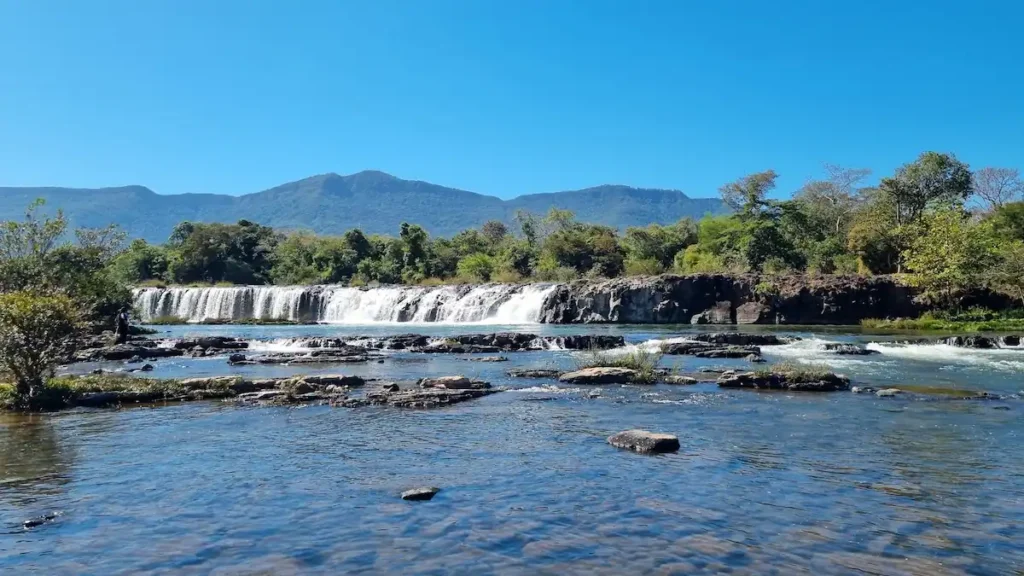
That’s where you come out of the jungle path and enter an open river section of the Namnoy River. In this part, the river is wide, as are the waterfalls along it. There are some interesting rock formations with flat sections, which make it suitable for setting up a tent for camping. Just keep following the river upstream on the right-hand side before the next turning points. It’s a beautiful open area in the middle of the valley on the foot of the river surrounded by mountains. Several waterfalls leading the way. Not quite high, but wide waterfalls with flat rocks everywhere.
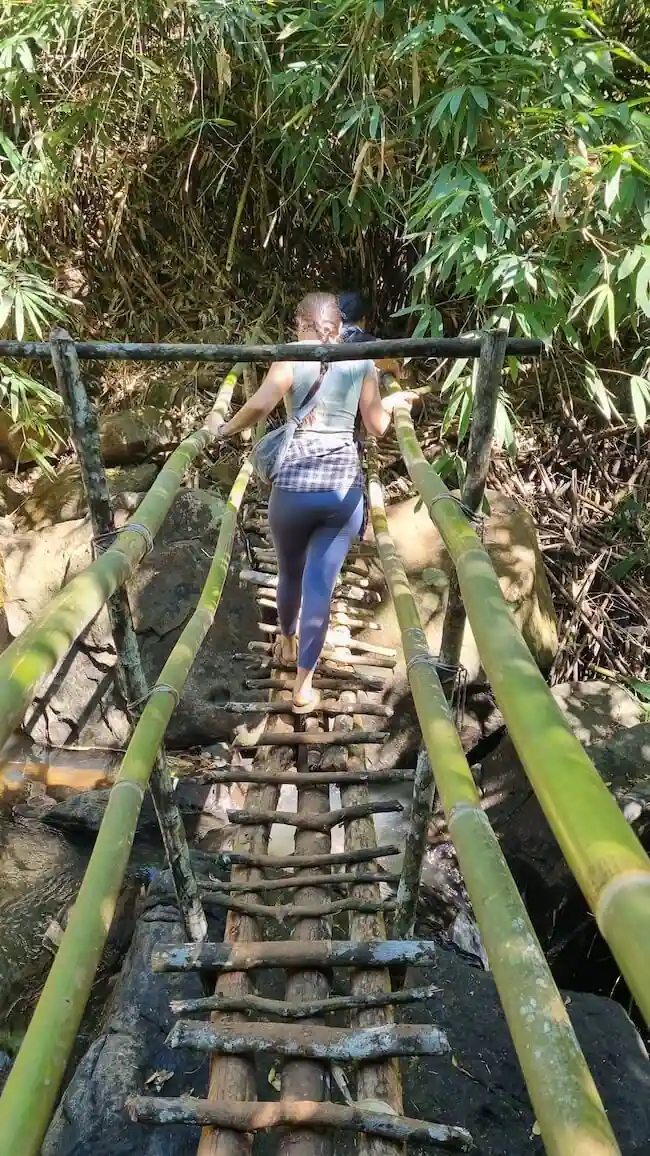
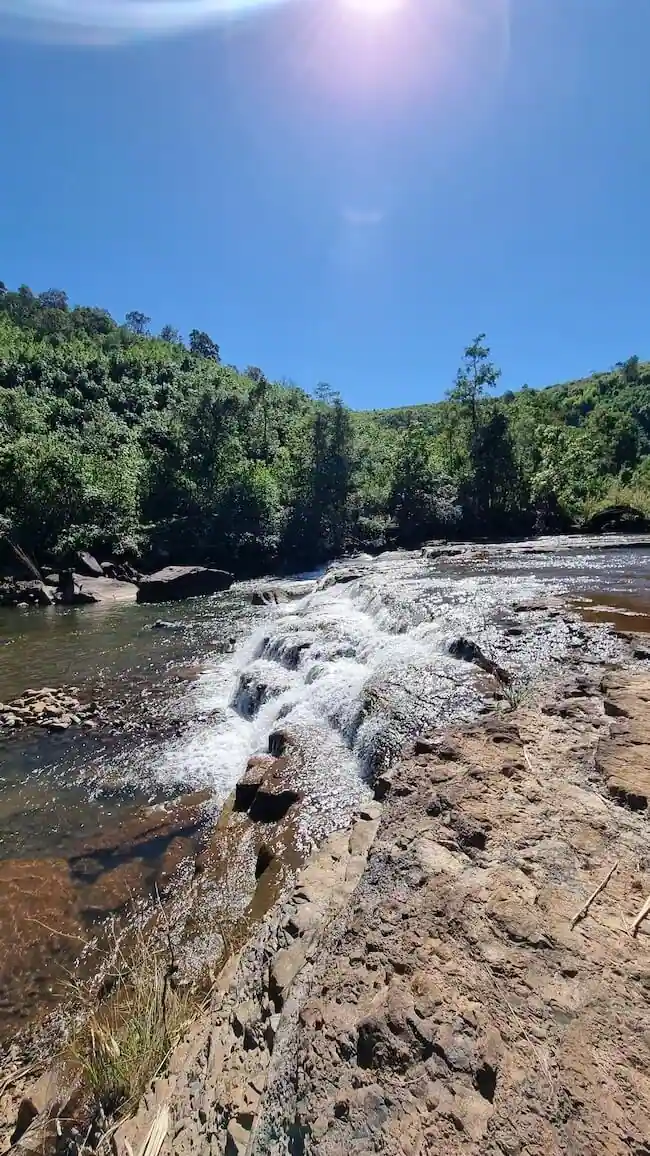
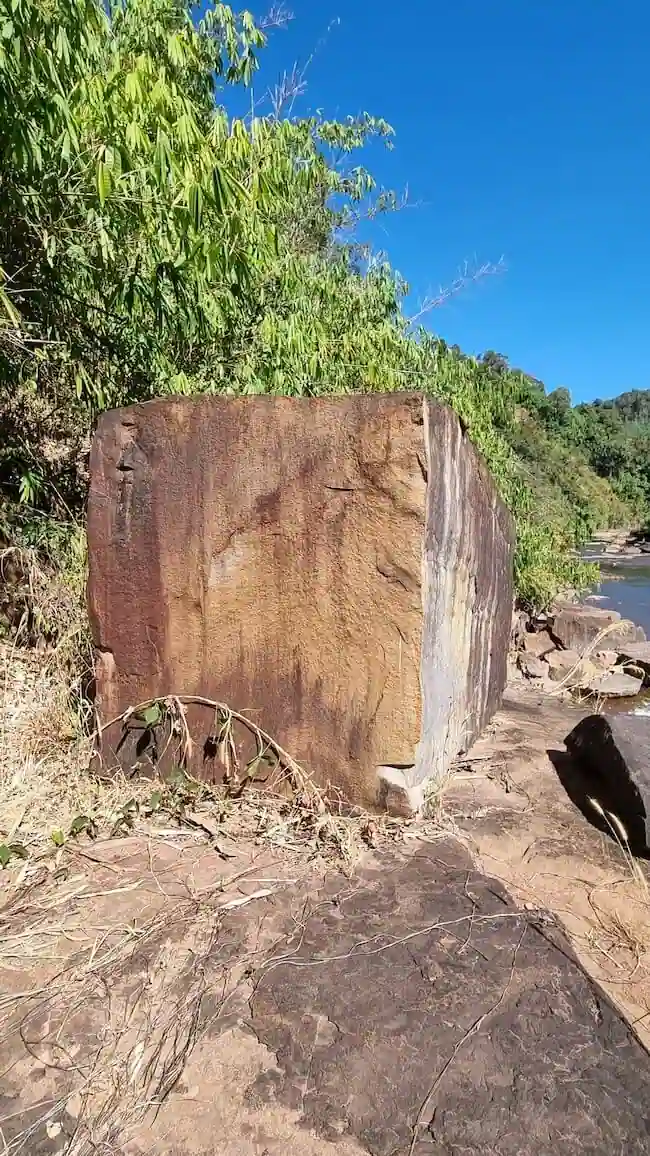
At some point, you will see some dodgy bamboo bridges crossing the river on the left side and a small bamboo bridge leading into the jungle on the right-hand side. If you want to reach the last two waterfalls, called Marut and Yarim, you have to cross the river using the bamboo bridges and continue on the left side of the river. This part of the trail leads back into the jungle and is quite overgrown, with no signs at all. Just continue until you reach the two waterfalls. This is a dead end, and you will need to return the same way you came, crossing back over the bamboo bridges.
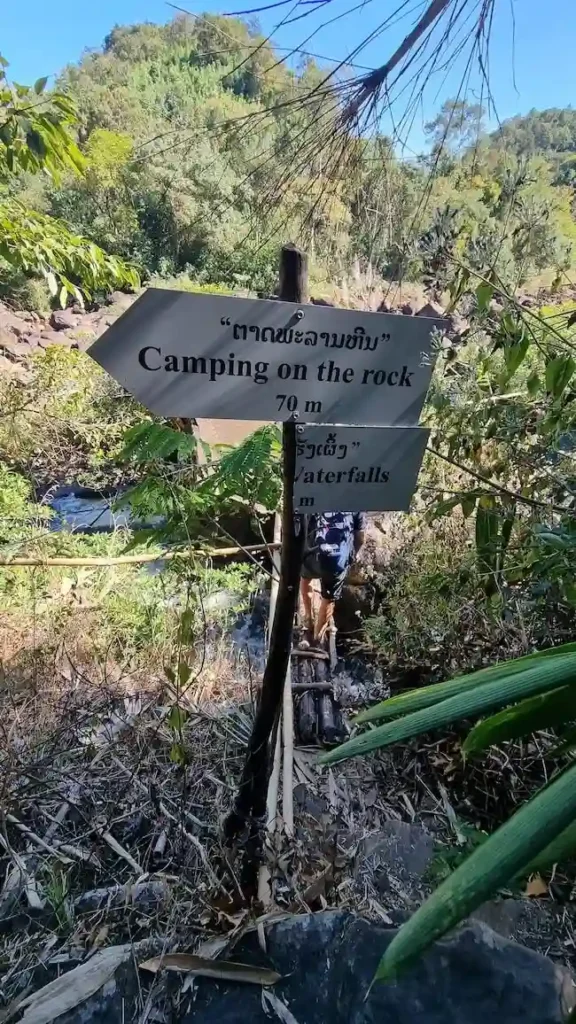
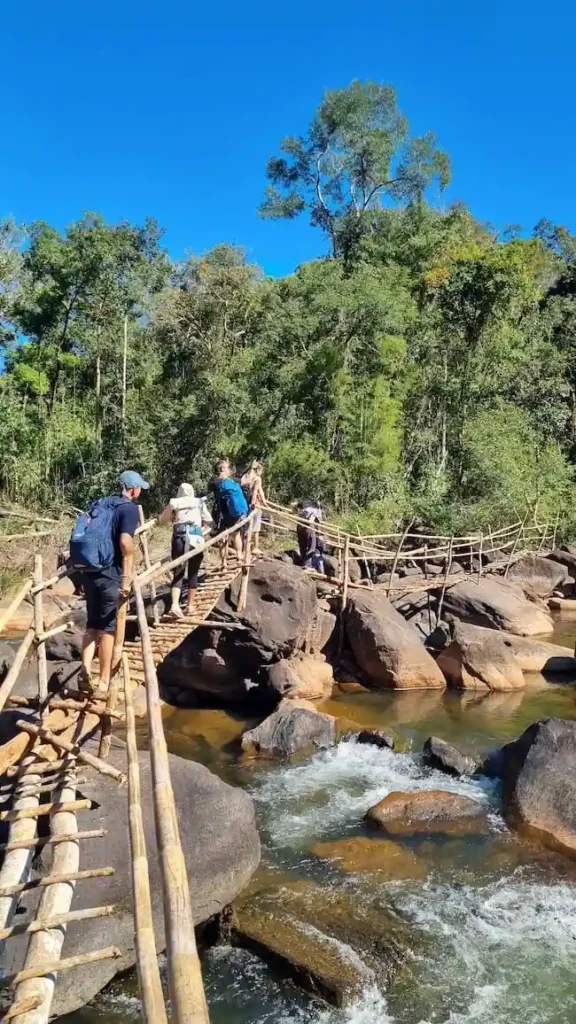
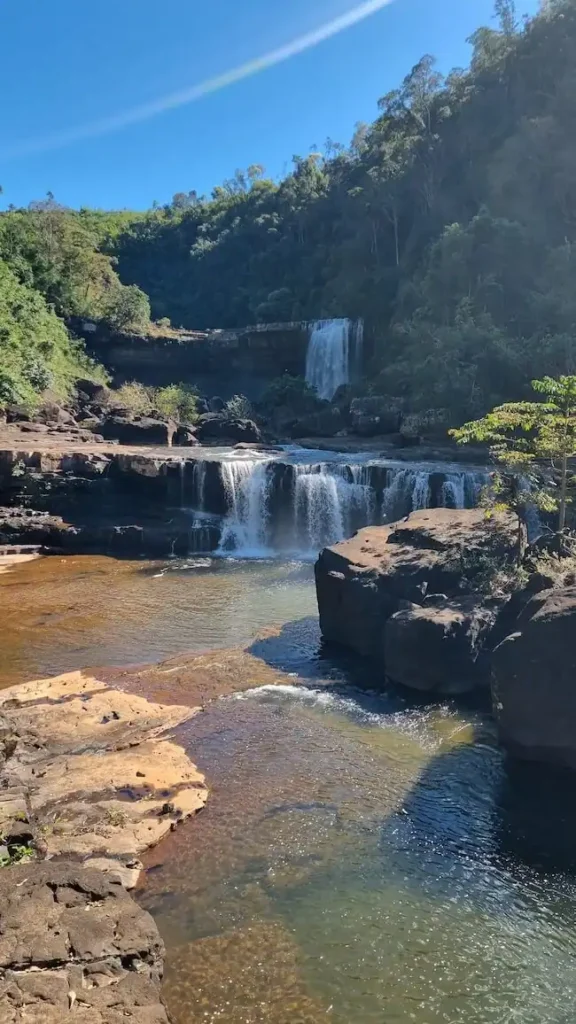
If you want to skip Marut and Yarim waterfalls, do not cross the bamboo bridges. Instead, take the small bamboo ladder up into the jungle on the right-hand side. This path leads to Mandreun Waterfall and back towards the Tad Tayicseua homestay. That part of the trekking path is quite steep, so be prepared to make some altimeters. Still, it’s nothing not manageable if you’re just a bit fit. You will find signs again showing you the directions to either the homestay or Mandreun waterfall. I totally forgot to take pictures at Mandreun waterfall, but below you can find an immersive 360-degrees drone tour of the whole Tad Tayicseua valley with all the spots on the hiking trail.
Tad Tayicseua Valley can be visited all year-round, but the experience changes depending on the season. The dry season in Laos from November to April or May is the most comfortable time to explore the valley. Trails are easier to walk, river crossings are manageable, and road conditions are generally good. During this time, the waterfalls carry less water, but the area is safer and easier to access.
The rainy season from May or June to October transforms the valley into a much more dramatic landscape. Water levels rise, waterfalls become more powerful, and the entire valley turns lush green. However, trails can be slippery, bamboo bridges more challenging, and some river sections harder to cross. The last part of the dirt road can also become muddy and difficult to ride, especially for less experienced riders.
For photography, late morning to early afternoon works best, especially at Tad Jarou Halang, where sunlight often creates rainbows in front of the waterfall. If you plan to hike the full trail and explore several waterfalls, staying overnight allows you to visit early in the morning or late in the afternoon, when the valley is quiet and the light is softer.
Tad Tayicseua Valley is a remote and mostly undeveloped area, so a certain level of caution is required. The hiking trails are natural jungle paths and can become slippery, especially after rain. Good footwear with grip is strongly recommended, as rocks near the waterfalls are often wet and uneven. Doesn’t apply if you’re a local, they will hike even in flip flops ;).
Several sections of the trail involve bamboo bridges and river crossings. While they are commonly used by locals, they can feel unstable, particularly during the rainy season or after heavy rainfall. Always test your footing and take your time when crossing.
There is very limited mobile phone signal in the valley and especially on the trail. Do not rely on internet access or Google Maps while hiking. Offline maps and a basic sense of direction are helpful, especially when exploring the more overgrown sections of the trail where signs are missing. At the homestay the mobile carrier Unitel has quite a good 4G+ connection. Read our Laos Sim Card Guide to find out what’s your best options to stay connected.
There are no rescue services or official safety infrastructure in the valley. If you plan to explore deeper parts of the trail, let someone at the homestay know where you are going and avoid hiking late in the day.
Tad Tayicseua is not part of the small Bolaven Plateau Loop, which most travelers complete in three or four days. Instead, it fits much better into the big Bolaven Plateau Loop, where more time is available and routes are less rushed. Because reaching the valley requires a detour on smaller roads and a dirt track, many riders skip it and stick to the more popular waterfalls directly along the main loop.
For travelers doing the Big Bolaven Plateau Loop, Tad Tayicseua is a rewarding side trip, especially if you enjoy remote areas and quieter routes. Starting point is always the town of Pakse, which is the biggest town in Southern Laos. The detour adds time to the day, but it also leads to one of the least visited and most diverse waterfall areas on the Bolaven Plateau in Southern Laos.
If you are riding the Small Loop, Tad Tayicseua is usually too far off the standard route to be included comfortably. In that case, it only makes sense if you extend your trip or switch to the Big Loop itinerary.
Planning an overnight stay at Tad Tayicseua Homestay turns the detour into a highlight rather than a time pressure. It allows you to explore the valley properly and continue the loop the next day without rushing.
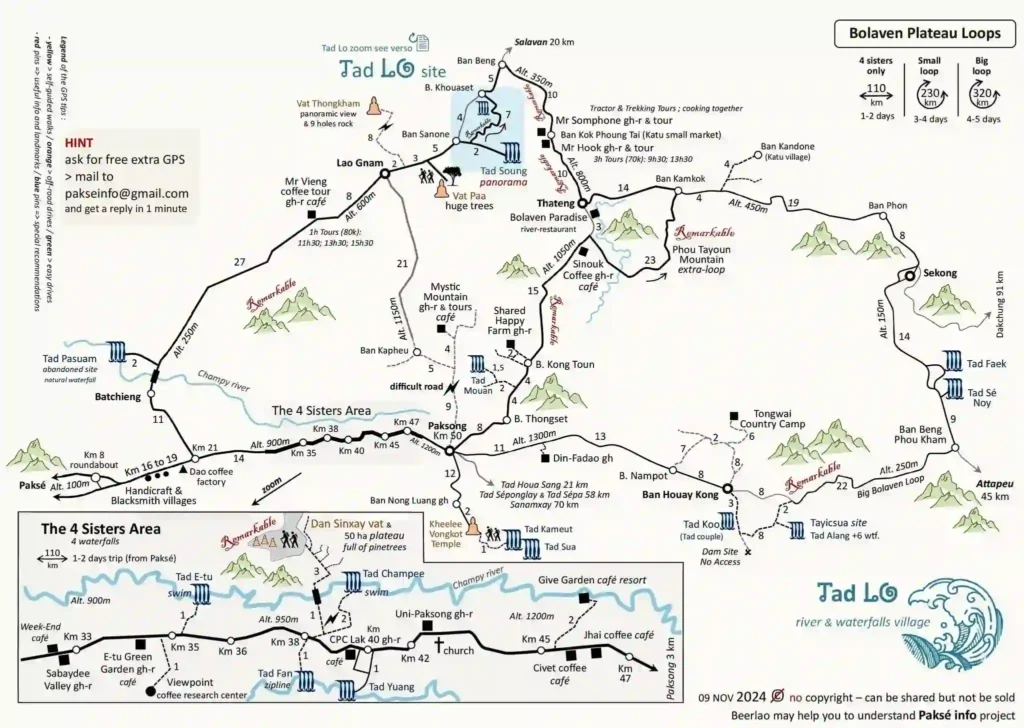
If you prefer doing the big or small loop on the Bolaven Plateau is totally up to you and depends on how much time you want to spend on the plateau. Personally, I would highly recommend doing the detour and adding an additional day or two if you are a slow traveler, to also explore the waterfalls on the big loop. Doing the big loop will give you an extra set of at least nine waterfalls: Tad Hua Khon, Tad Faek, Tad Khoo, and the Tad Tayicseua Valley.
After living in Laos for some years now, I would even say that the whole Tad Tayicseua Valley is one of the best destinations in southern Laos. I have heard others say that the detour is not worth it, which I cannot confirm. It’s Laos, so take your time and PDR (please don’t rush)!
| Bolaven Plateau Loop | Small Loop | Big Loop |
|---|---|---|
| Typical Duration | 3–4 days | 4–5 days |
| Road Type | Mainly paved roads | Paved roads, dirt roads and remote sections |
| Traffic & Popularity | Busy, but only near Pakse & Paksong | Quiet and much less visited |
| Waterfalls Access | Easy access, directly along the route | More remote waterfalls with detours |
| Tad Tayicseua Valley | Not included | Ideal detour |
| Navigation Difficulty | Easy with Google Maps | More challenging, GPS and local knowledge recommended |
| Recommended For | Short trips, first-time visitors | Experienced riders, slow travelers |
| Overnight Stay at Tad Tayicseua | Not practical | Highly recommended |
Tad Tayicseua is a remote waterfall valley on the Bolaven Plateau made up of seven different waterfalls connected by jungle hiking trails. It is not part of the classic Small Loop and works best as a detour on the Bolaven Plateau Big Loop, ideally with an overnight stay. Access requires some riding experience, especially during the rainy season, but rewards visitors with one of the most diverse and least visited waterfall areas in southern Laos. If you enjoy slow travel, hiking, and quiet nature far from crowds, Tad Tayicseua is well worth the extra effort.
Tad Tayicseua Valley consists of seven different waterfalls (not only one), all connected by jungle hiking trail. Some are easy to reach, while others require more walking through remote sections of the valley. But all in all easily doable.
No. Tad Tayicseua is not part of the classic Small Bolaven Loop. It fits much better into the Bolaven Plateau Big Loop or as a dedicated detour with an overnight stay.
A short visit is possible, but one full day or an overnight stay is highly recommended if you want to explore several waterfalls and hike the valley without rushing.
The trail is moderate, but it is a natural jungle path. Some sections are steep, muddy, or overgrown, and signs are missing in parts. Basic hiking experience and good footwear are recommended. Can be completed in 2-3 hours.
Tad Tayicseua is suitable for all kinds of travelers, including solo hikers, couples, and families with children. Some of our relatives visited the valley with kids aged between 2 and 8 years, which was also possible.
Mobile phone reception is very limited or not available at all in many parts of the valley. Do not rely on internet access or online navigation while hiking. The homestay area has good internet connection, so make sure to have a lao sim card.
Yes, if you enjoy remote nature, hiking, and quiet places. If you prefer easy access, comfort, or short stops, other waterfalls on the Bolaven Plateau may be more suitable. From the perspective from someone who lives in Laos, I would highly recommend it!