Is it fast enough to work online in Laos?Β
As the the number of people who are traveling and working remotely simultaneously grows, it’s important to know about the reliability and connectivity of the internet in a country. Working remotely in Laos as a Digital Nomad nowadays is no problem as the infrastructure is developing fast. Besides the internet connection in Laos, I encourage everyone who is planning to visit the Lao PDR, to get familiar with general local customs, traditions and other important travel details by reading our extensive Laos Travel Guide.Β In this article I want to share my personal experience about the internet speed in Laos as the owner of an online business and a digital nomad myself.Β
The Internet was officially Introduced in the late 90’s, but back then it was quite expensive and slow like in many parts of the world. But from 2010 onwards, the internet throughout Laos developed rapidly with the introduction of 3D and later followed by 4G from most of the internet providers in the country. A Laos digital report from 2023 shows that 85% of the lao population are mobile phone users and 62% already have access to the internet, despite economical and infrastructural challenges within Laos. Locals use the internet mainly for Social Media networks like Facebook, Instagram or TikTok. Thanks to the Development of better internet speeds, many young Laotians trying to build income streams with Social Media Platforms.Β
To reassure those who work online, it can be said that the internet in Laos is generally good. According to the global speed index, Laos has an average mobile speed of almost 50 Mbps and fixed broadband speed of around 40 Mbps. It is not as fast as in Thailand, which has one of the fastest internet speeds in the world and at the same time it is also not as bad as in the Phillipines, where I experienced some of the worst internet in southeast Asia.Β
2026 Update: While robust 4G networks cover almost the entire country, major providers like Unitel & Lao Telecom have now officially launched high-speed 5G coverage in major urban centers. However, internet speeds in Laos are not always exactly the same, depending on different things. Here are some factors which have an influence on Internet Speed:
Β
The typical tourist in Laos, will probably stick around cities like Luang Prabang, Vientiane, Vang Vieng, Thakek, Savannakhet or Pakse anyway. In all of those mentioned areas, you will have absolutely no problem to have a good and stable internet connection with the biggest providers like Unitel or Lao Telecom. Almost all hotels and even smaller guesthouses nowadays have WiFi and if thats too slow, just use your smartphone for a mobile hotspot. Even in any other provincial cities like Phonsavan or Nong Khiaw.Β Β
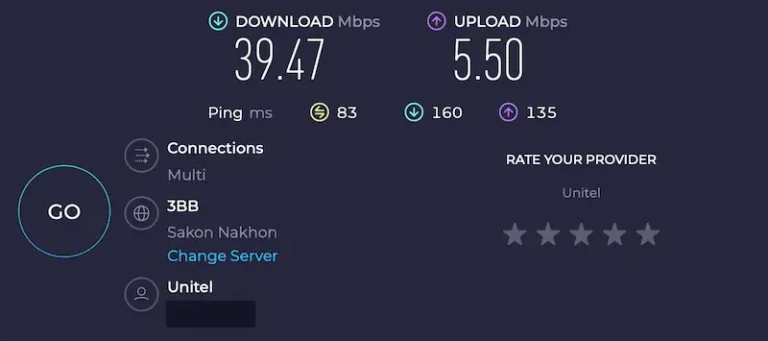
The time of the day is something to consider when talking about how fast the Internet in Laos is. It can be said, that the internet is faster in the morning, mid-day, early afternoon and gets a bit slower late afternoon or evenings when many locals using social media or watching videos after a hard day of work. That being sad it doesnt mean that the internet gets unusable, but just a bit slower. I did a comparison of speed tests during different times of the day using my Lao sim card from Unitel as a mobile hotspot connected to my laptop and those were the results.Β

Internet speed test Unitel sim card as mobile hotspot in the morning. Internet speed as good as it gets in a bigger city (Savannakhet). Working and video calls are smooth. Just upload speed is a bit slow in general. Ping and latency are also alright during that time of the day. Source: speedtest.net

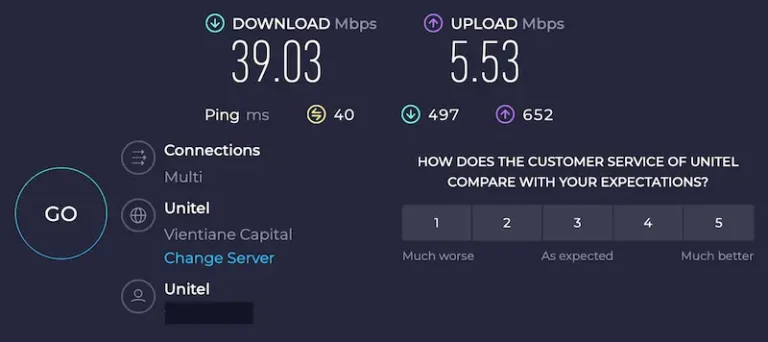
The speed test in the afternoon showed similar results like in the morning. It was done around 2 pm with the same sim card at the same spot. Ping got a bit better, while download and upload latency got a bit worse early afternoon. All in all not a significant difference. Source: speedtest.net

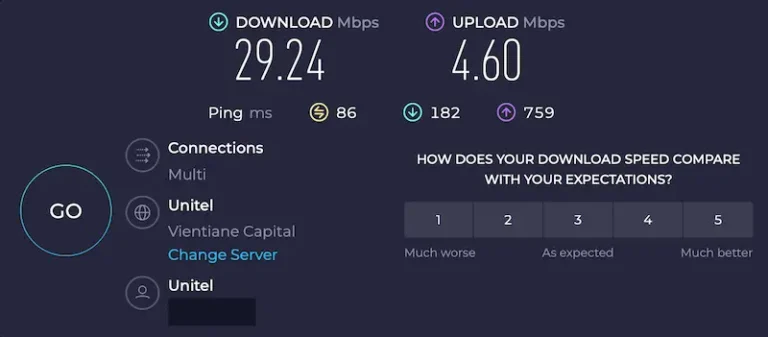
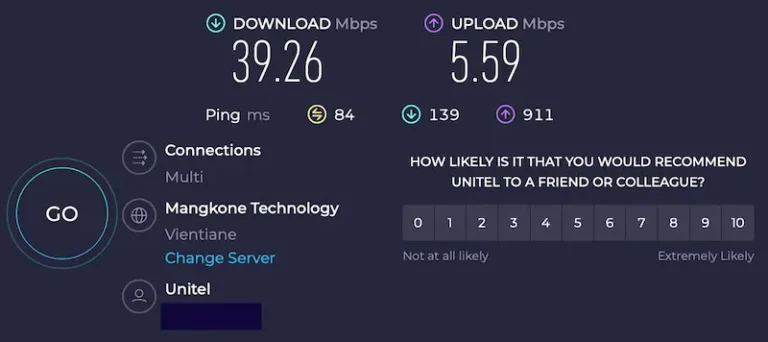
This speed test done on the same day just a bit after 7 pm, which is beginning of prime time for many people to heavily use social media, youtube, etc. Thats why the download speed dropped significantly and upload latency went up, which is another indicator for people streaming, watching videos, etc. Source: speedtest.net

The speed test done around 10 pm showed similar results. The download speed got faster again compared to the evening test, while the upload latency got a bit worse during that time. Uploading and streaming can be a bit slower at night, but is still feasible. Ping and download latency stayed about the same as a few hours earlier. Source: speedtest.net

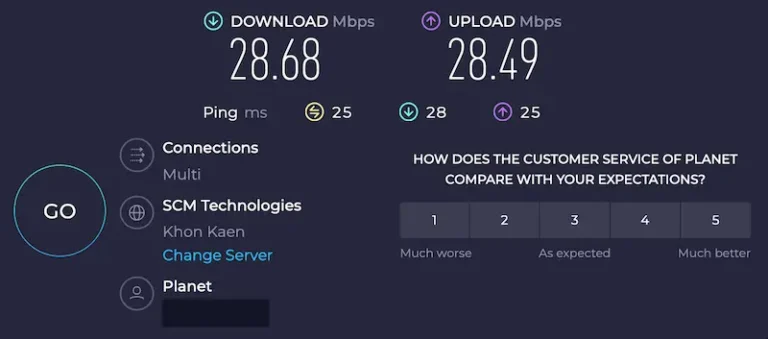
This was tested in the evening with my home Wifi (company called Planet). Download is a bit slower than Unitel, but upload significantly better as well as ping and latency are better. So I prefer the home Wifi for video calls in the evening. Its likely that guesthouses have a similar landline provider. Source: speedtest.net

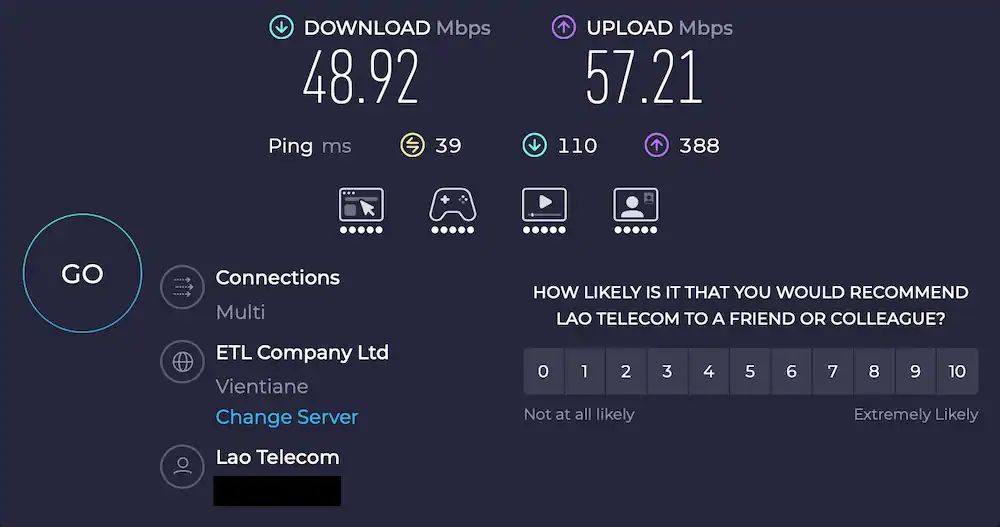
I also tested my Lao Telecom SIM card using it as a mobile hotspot (July 2026). The results below were recorded in the morning. Internet speeds in Laos vary depending on your location and provider, and even within the same city one network may perform better than another. Unitel and Lao Telecom are the two most reliable providers. Source: speedtest.net

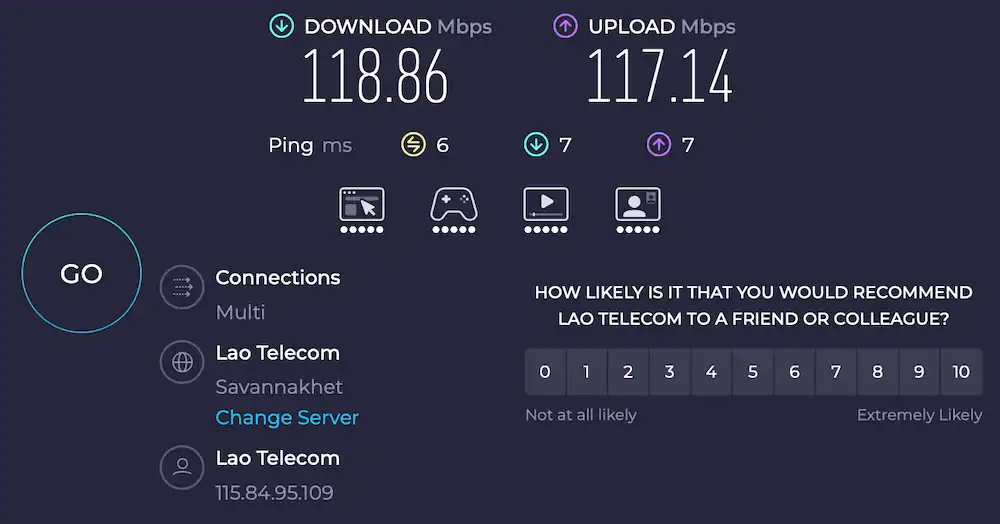
The results were recorded using a Lao Telecom FTTH (Fiber to the home) home fiber connection (July 2026). The connection delivered excellent download and upload speeds with very low latency, making it ideal for remote work, video calls, and large file uploads. For those deciding on home WiFi, it can be a good option. Source: speedtest.net
To understand the metrics of an internet speed test, let me give you a brief explanation about those numbers in general:Β
Download Speed (Mbps) β Measures how fast data is received from the internet. Higher speeds indicate faster browsing, streaming and downloads. Ideal Range: 10+ Mbps for basic use, 50+ Mbps for HD streaming, and 100+ Mbps for gaming or heavy downloads.
Upload Speed (Mbps) β Determines how fast data is sent from your device to the internet. Essential for video calls, cloud backups, and online gaming. Ideal Range: 5+ Mbps for video calls, 10+ Mbps for large file uploads, and 20+ Mbps for professional streaming.
Idle Latency = Ping (ms) β Measures the delay in communication between your device and the server when no data transfer is actively occurring. Can be described as time and indicates network responsiveness. Ideal Range: Below 50ms for smooth online experiences, under 20ms for gaming or VoIP.
Download Latency (ms) β The time delay experienced while receiving data. High download latency can cause buffering in streaming and slow webpage loading. Ideal Range: Below 100ms is good, under 50ms is ideal.
Upload Latency (ms) β Measures the delay in sending data. Affects live streaming, video calls, and gaming performance. Ideal Range: Below 100ms is acceptable, under 50ms is excellent.
I am working as a digital nomad since over 8 years now and experienced working from several different countries. My work consists of a mix of Webdesign, Online Marketing, editing of 3D & 360 tours, video calls with zoom and voice calls with WhatsApp. I usually dont have any troubles getting my work done during any time of the day. Just when working during peak hours between 7-10 pm, network and network response time can be a bit slower with a Unitel sim card or in general with any other sim card. For me that means longer loading times when using a Webdesign-Pagebuilder such as Elementor or sometimes smaller glitches during videos calls. But it was never that bad, that the video calls were not feasible, so still efficient during those 2-3 peak hours of the day. The rest of the day is always fine.
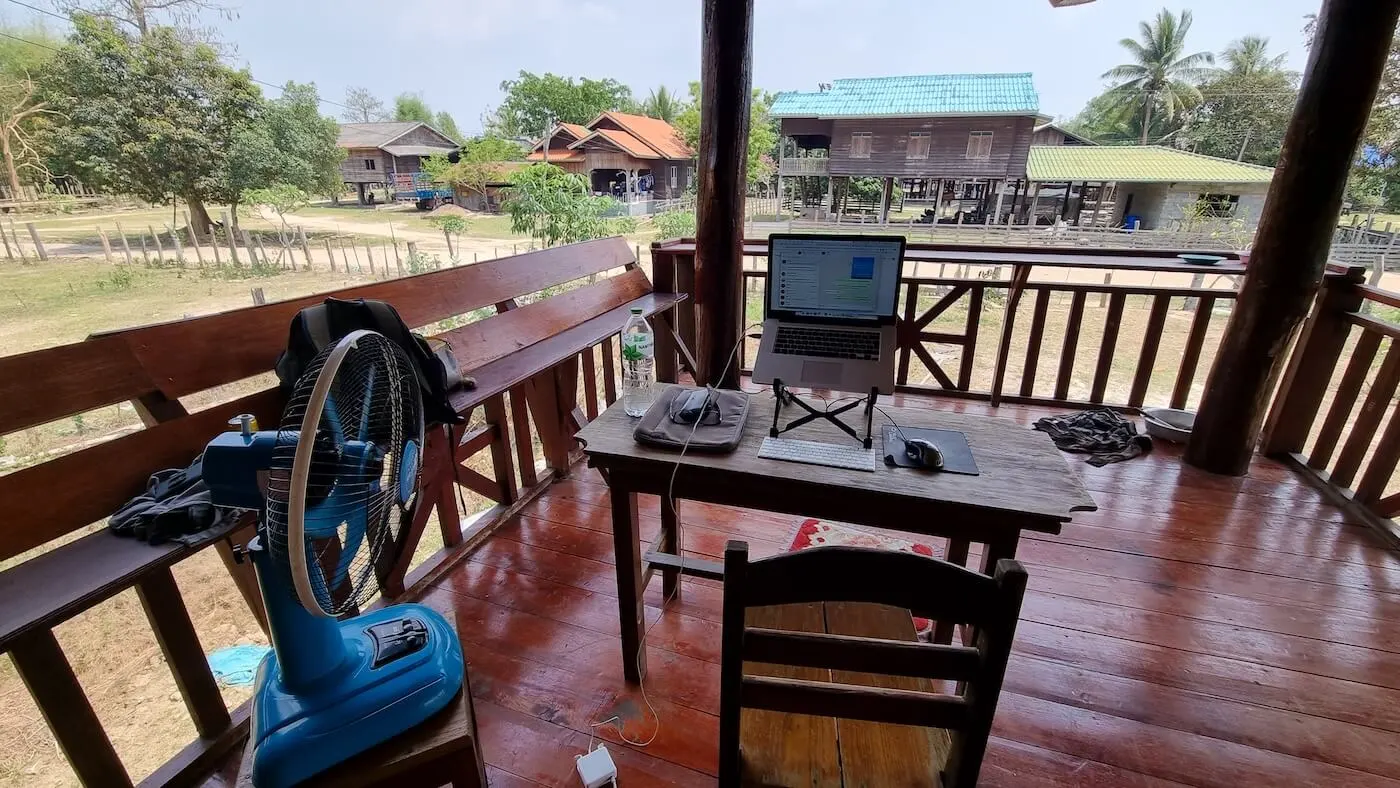
I even worked from very remote rural villages in Laos, where the download speed even reached over 50 Mbps! But in rural villages internet may not be consistent and sometimes you will not even get a 4G connection. So better to do your work in towns or cities instead of small rural villages. But for most visitors to Laos, they will never get to those remote places anyway.
For me the internet speed in Laos, data packages and prices are much better compared to my home country Austria. I am from a small town in Austria and one of the richest countries in the middle of Europe could still not figure out how to provide proper and affordable internet connection to every town. Even a third-world country like Laos is developing much faster than my home country, at least when it comes to providing internet to its citizen. Shame on you, Austria!Β
There are a handful of internet and mobile carriers in Laos. In 2026 Unitel is the biggest provider and offers great coverage all around the country from northern Laos to the south. I have good experiences with Unitel since many years and even in very rural areas they sometimes have stronger signal than in urban parts of the country where there are a lot more users at the same time which uses up lots of bandwidth.Β
Second biggest provider is the state-owned Lao Telecom (LTC), which also works fine in major towns and some rural areas. If you are considering working remotely in Laos, I would recommend simply getting both sim cards, one from Unitel and one from Lao Telecom (eSims available). Having both ready gives you peace of mind and you’re always connected. Sometimes even within a city, one provider works better than the other one.Β
TPlus and ETL have more limited networks, primarily serving urban centers with less presence in rural regions. Therefore, for the most comprehensive coverage across Laos, Unitel stands out as the leading provider.
Planning your trip to Laos? Don’t make the mistake of buying a random SIM card at the border or airport! To get the absolute best network coverage and fast speeds without getting ripped off, you need to know which provider to choose and where to buy. In Laos, high-speed mobile data is incredibly cheap. You can easily get over 30 GB of data for 30 days for just $5 to $10 USD. Whether you want a traditional physical SIM card from Unitel or Lao Telecom, or you prefer the convenience of activating a Lao eSIM on your phone before you even cross the border, we cover everything in our sim card guide.Β
β‘οΈ Laos SIM Card Guide to discover local data packages, pricing, coverage for 2026/27
For most travelers going through Laos, Landline/FTTH is probably not relevant. But the WiFi availability in a hotel or guesthouse is. Most of the accommodation now have a Wifi connection for their guests. Usually a connection which is also quite useful. But the same is true for WiFi: the more people use it, the slower it gets. For online workers and digital nomads in Laos it is therefore important to buy a sim card straight after arriving or a Lao eSim before arriving as a backup if the hotel Wifi isn’t reliable.Β
Yes, 5G is officially available in Laos and its rollout has accelerated significantly in recent years. Unitel, the countryβs largest mobile network, now offers 5G coverage in many major cities and tourist destinations, including Vientiane, Luang Prabang, Vang Vieng, Pakse, Savannakhet, and Thakhek. Lao Telecom has also started expanding its 5G network in selected urban areas.
If youβre staying in city centers or traveling along Laosβ main tourist routes, you can easily access a reliable 5G connection with a compatible smartphone and a local SIM card or eSIM. Outside larger cities, your device will automatically switch to 4G/4G+, which still provides more than enough speed for video calls, streaming, navigation, and remote work. Based on my own experience living and working in Laos, I rarely notice any limitations when using either Unitel or Lao Telecom.
Many digital nomads & remote workers overlook Laos when choosing their next spot to work remote from. Laos is still not as popular for digital nomads as mass touristic Thailand (luckily). Still, more and more people considering Laos as their next digital nomad base. The country getting more and more into the spotlight for online workers and thats for some reasons:Β
Why do so many people talk about a VPN connection when traveling abroad, and what exactly is it? Many people promote a VPN like NordVPN not only to earn an affiliate commission, but for a very good reason! A VPN (Virtual Private Network) simply encrypts your internet connection, hides your IP address, and allows secure and private browsing by routing your traffic through a remote server.
When traveling, you constantly log into different Wi-Fi networks in cafΓ©s, hotels, or guesthouses, and sometimes they don’t even have a secure password. By logging into such unsecure networks, your data could be compromised, and your passwords, credit card details, or personal files could be fully exposed to anyone else on that same network.
Especially when using banking apps, online wallets, or other platforms where sensitive credentials are needed, turning on a premium VPN is an absolute must. I highly recommend using a reliable provider like NordVPN. Watch the video below for a simple explanation of what a VPN is and how it protects you on the road.
Let me share a quick, real story that happened to me: A while back, I carelessly let my VPN subscription expire and browsed on public Wi-Fi networks without protection. Shortly after, two of my primary debit cards were compromised. Thieves managed to scrape my details and hit my accounts with dozens of small, quiet $10 purchases in the Apple and Google Play stores. Getting stuck abroad with blocked cards is a massive nightmare. Lesson learned: I never handle financial tasks or browse sensitive sites without a VPN anymore.
Security aside, a VPN is essential in Laos to bypass annoying geo-blocking. Many international streaming platforms, banking portals, and news sites can block incoming traffic from Lao IP addresses. For instance, whenever I want to stream live TV from back home in Austria, itβs completely blocked unless I use a VPN to shift my digital location back to Europe.
Iβve been using NordVPN for years because it is fast (it won’t slow down your Lao internet connection), highly secure, and very affordable.
With an average download speed of around 30β40 Mbps and an upload speed between 5β28 Mbps, the internet speed in Laos is definitely good enough if you need to work online. You will find reliable internet infrastructure throughout the country, especially in urban areas.
Hotels and guesthouses provide decent Wi-Fi connections, but if thatβs not enough, simply get a local Lao SIM card and use it as a mobile hotspot. If you are traveling extensively, especially further away from tourist spots and into more remote areas, it is highly recommended to get a second SIM card as a backup. Using a Unitel SIM or eSIM as your primary connection and a Lao Telecom SIM card as a secondary one is the best strategy.
SIM cards and data plans are incredibly cheap in Laos. For just $5 to $10 USD, you can easily get over 30 GB of data for 30 days. To find out exactly which packages to choose, head over to our comprehensive Laos SIM Card Guide.
Disclosure: This article contains affiliate links. If you make a purchase through them, we may earn a small commission and you support our blog to write more helpful articles β at no extra cost to you.Β