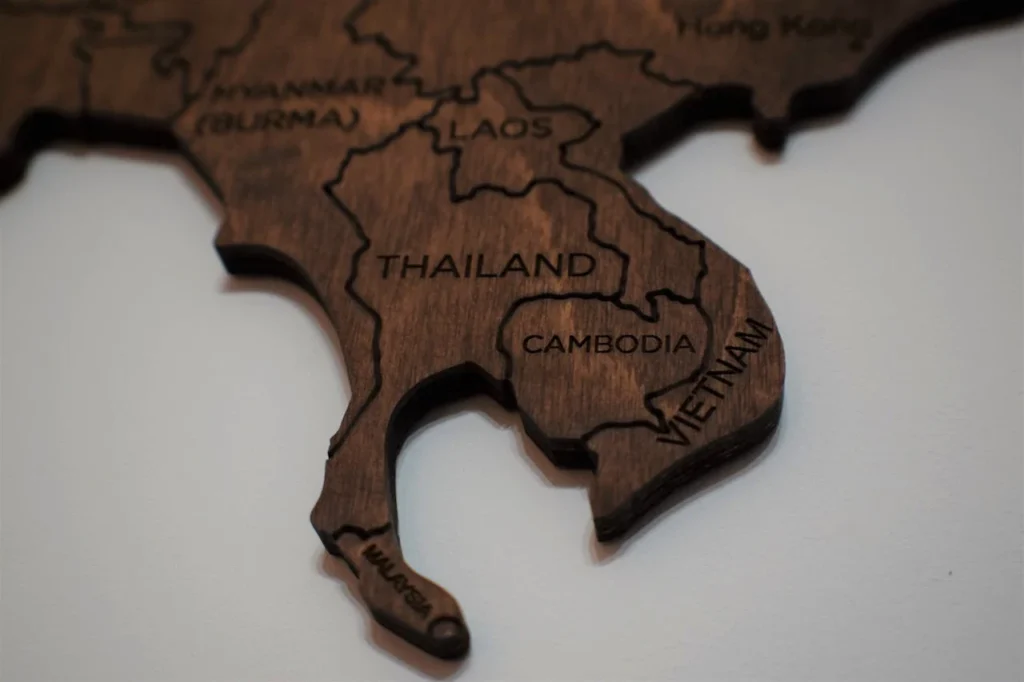

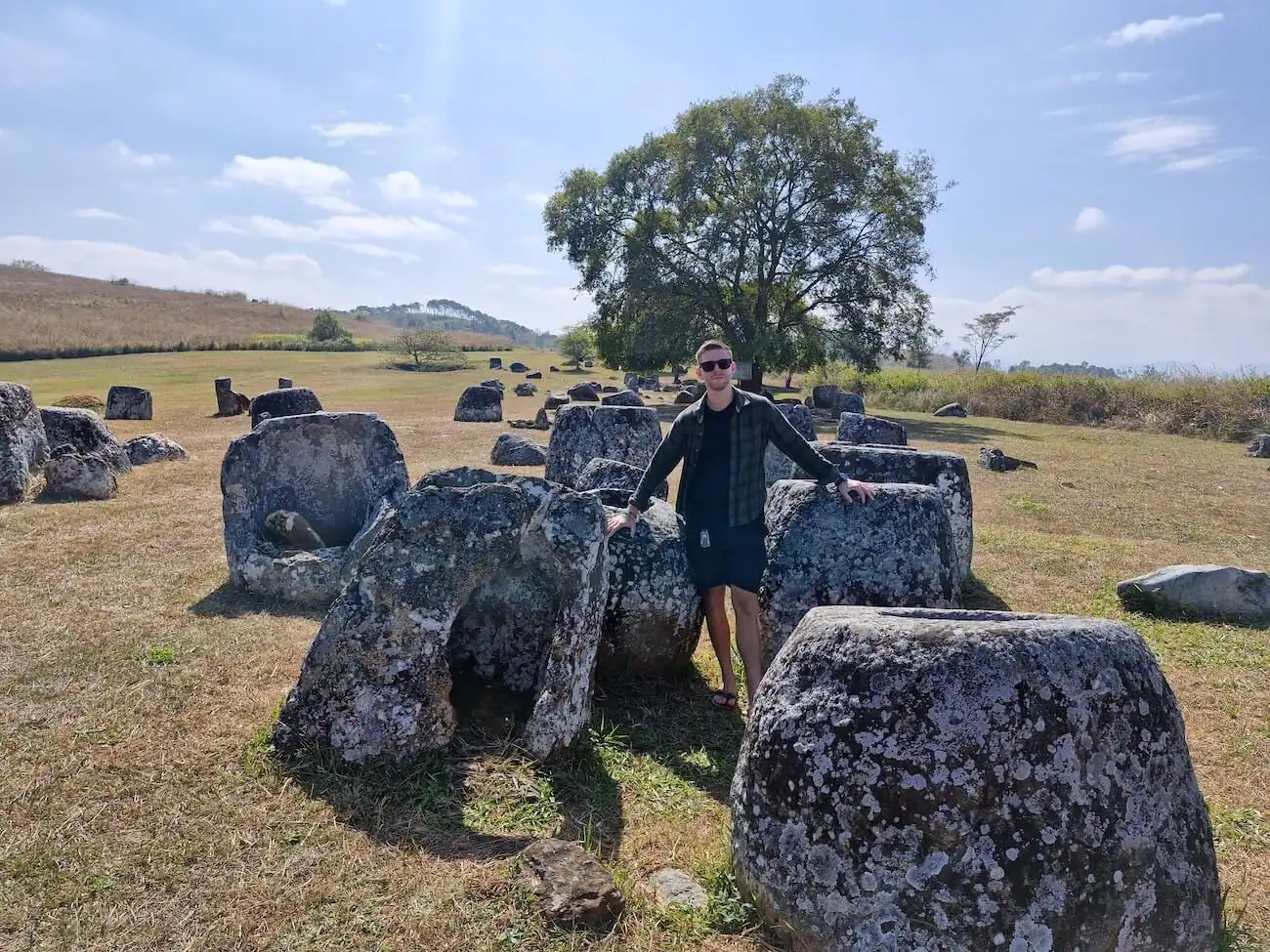
The Plain of Jars in the Region of Northern Laos is one of the most unusual and mysterious places in Laos. Spread across the uplands of Xieng Khouang Province near the city of Phonsavan (Provincial Capital), these ancient stone jars appear in clusters across open landscapes, hillsides, and fields, creating a scene that feels impressive and strange at the same time. Some jars are enormous, many are weathered by time, and their original purpose is still not known with complete certainty.
That mystery is exactly what makes the site so interesting, but the Plain of Jars is important for much more than its appearance alone. It is one of the most significant archaeological landscapes in Laos and was recognized as a UNESCO World Heritage Site for its outstanding historical value. The wider region also carries the scars of the Secret War in Laos, which adds another layer of meaning to any visit today. It was one of the most bombed Provinces in Laos during the American-Vietnam war. Bombed by USA as a desperate act. More on that later on.
For visitors, it is not just a famous landmark, but a place where archaeology, legend, and the deeper story of Laos all come together in a way few other destinations in the country can offer.
The Jars are spread across different sites in Xieng Khouang Province in northern Laos. The three main sites that most visitors go to are Site 1, Site 2, and Site 3. The provincial capital, Phonsavan, is the main base for visiting the Plain of Jars. From there, it is easy to arrange transport, hire a driver, or rent a motorbike to explore the sites.
Unlike some attractions in Laos that are visited as a quick roadside stop, the Plain of Jars covers a wider area. The best-known and most accessible sites can all be reached from Phonsavan.
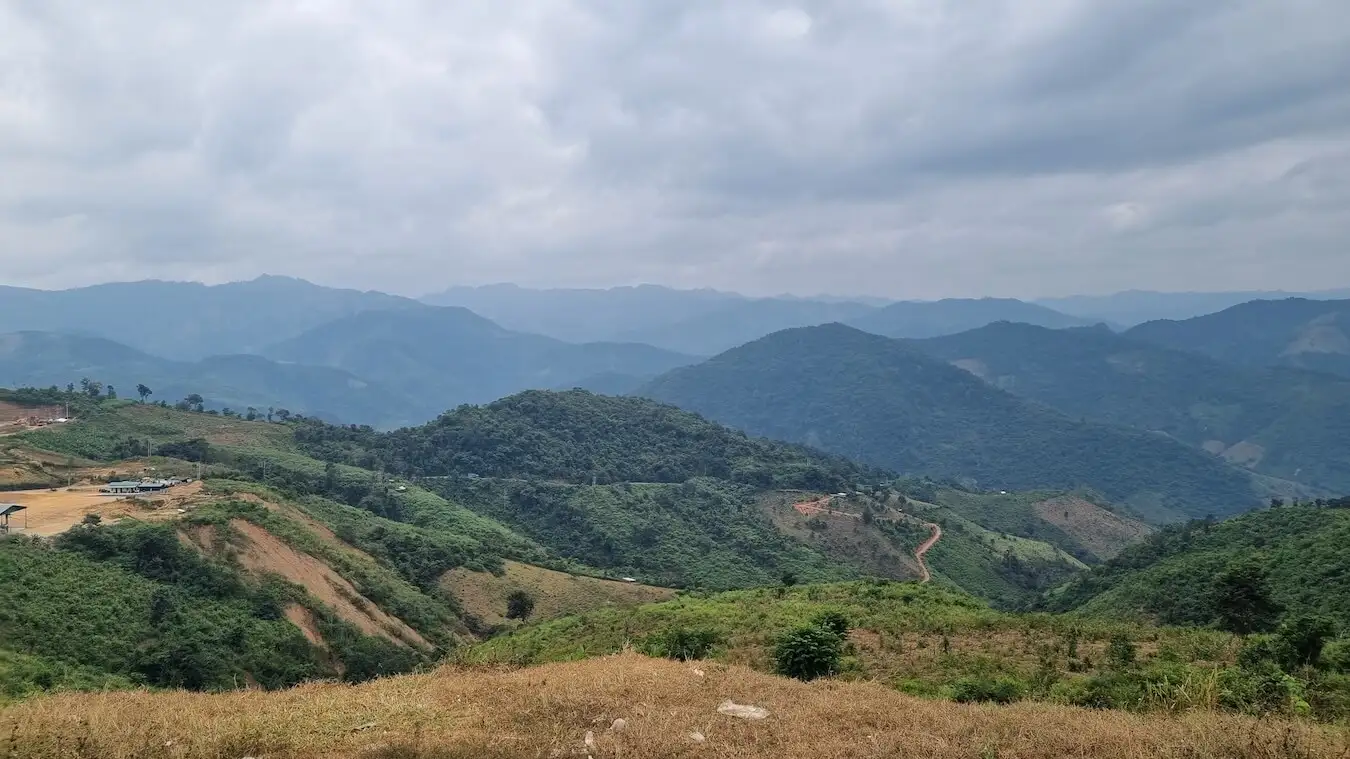
First of all: Make sure to bring a lot of time if you want to visit the Plain of Jars. It’s quite a journey to get there if you go overland by road. Xieng Khouang is located in a mountainous area in the North of Laos and the roads to get there are not in a good condition as in many parts of the country.
Once you are in Phonsavan, visiting the Sites 1, 2 and 3 is quite easy, because they are all located within driving distance from town.
There are two main ways to get to Phonsavan: by road or by plane. Traveling by road is still the most common option for many travelers in Laos, but it takes time. The journey is known for long mountain roads, many curves, and bad road conditions.
🚌 By Bus or Minivan:
If you travel by bus or minivan, Vientiane, Vang Vieng, and Luang Prabang are the usual starting points. Travel time from Vientiane is around 10 to 12 hours, 8 to 9 hours from Vang Vieng, about 10+ hours from Luang Prabang and about 6 to 7 hours from Paksan. Keep in mind that the actual travel times can vary depending on road conditions and transport type.
Transportation in Laos is not always accurate when it comes to time schedules, departure times and travel time. Busses and minivans often pick up and drop off people on the way, which makes the trip even longer. That’s absolutely normal in Laos and Southeast Asia in general. Don’t expect exact timing! Booking such journeys online via 12Go Asia (and other similar platforms) is not a good idea. This service is not reliable in Laos and I would not recommend using it! Best is to simply show up at the bus station in Vientiane, Luang Prabang, Vang Vieng or Paksan and ask for departure times to Phonsavan. Go there and ask in the morning the day before you want to leave. Sometimes they have sleeper busses leaving in the evening and sometimes there are busses in the morning. Do it the old-school way and go ask. As easy as that. Stop thinking that you need to pre-book every step and stay flexible.
If you prefer comfort over saving money, many private drivers with 4×4 pickups will be happy to bring you to Phonsavan from Vientiane, Vang Vieng, Luang Prabang or Paksan. Your hotel or guesthouse can organize it for you or simply ask in one of the Laos Travel related Facebook Groups.
➡️ From Luang Prabang to Phonsavan around 260 km, 10+ hours via Phou Khoun, Roads Nr. 13 and Nr. 7
➡️ From Vientiane/Vang Vieng/Paksan to Phonsavan: Either going to Paksan via Road Nr. 13 and Road Nr. 1D (through Xaisomboun Province), Distance around 350 km, 9 to 10 hours at least. Or going towards Vang Vieng first and then via Kasi and Phou Khoun to Phonsavan, Distance 235 km, 8 to 10 hours
Road conditions to Phonsavan are bad. Views are nice though. We drove some of the mentioned roads with our own car and it’s quite an adventure. If you plan to travel by bus or van, be prepared for an adventure.
If you want to save time and avoid a long and tiring road journey on some adventureous mountain roads full of potholes, flying to Phonsavan is the easier option. Xieng Khouang Airport (XKH) is located close to the city and makes the Plain of Jars much more accessible than it used to be. Domestic flights are the best choice for travelers who are short on time or simply do not want to spend an entire day on mountain roads.
That said, the airport is not always operating continuously. Xieng Khouang Airport (XKH) was closed from 1 October 2024 to 31 May 2025 for renovation work and officially reopened in June 2025. Because of that, and because domestic flight schedules in Laos can change quickly, it is always a good idea to check the latest situation before planning your trip around a flight.
Currently there are two airlines flying from Vientiane (VTE) to Xieng Khouang Airport (XKH): Lao Airlines and Lao Skyway. There are daily flights from the capital to Xieng Khouang with departure times between 10 AM and 3 PM. Keep in mind, that this flight route might change in the future depending on demand. To find, compare and book a flight, I would recommend using Trip.com. I still found it one of the cheapest options when it comes to book flights in Asia.
The Plain of Jars is famous because it is one of the most unusual archaeological sites in all of Southeast Asia. At first glance, the giant stone jars alone are enough to make the place memorable. They are spread across open landscapes in a way that feels strange, mysterious, and hard to explain. But the real reason why the site is so important goes much deeper.
Nobody knows with complete certainty who made the jars or exactly what they were used for. That mystery has fascinated travelers, historians, and archaeologists for many years. At the same time, the site is not just known for its unanswered questions. It is also one of the most important prehistoric landscapes in Laos and was recognized as a UNESCO World Heritage Site because of its outstanding historical value.
Another reason why the Plain of Jars is so famous is the setting itself. Visiting the site is not just about seeing old stone objects in a museum like environment. The jars are still sitting out in the landscape where they have remained for centuries. That gives the place a very different feeling. It feels open, quiet, and powerful at the same time.
The wider region also adds to the significance of the Plain of Jars. Xieng Khouang is not only known for ancient history, but also for the scars left behind by war. Because of that, a visit here is not just about archaeology. It is also about understanding one of the most historically layered places in Laos.
That combination is what makes the Plain of Jars so special. It is mysterious, historically important, visually striking, and deeply connected to the wider story of Laos.
Nobody knows for certain who built the Plain of Jars. Archaeologists believe the sites were created by an Iron Age culture that lived in what is now Xieng Khouang, but there is no written record telling us exactly who these people were. That is one of the main reasons why the Plain of Jars remains so mysterious. What is clear is that the people who made and moved these massive stone jars must have had strong technical skills, good organisation, and a clear purpose for creating such an impressive landscape.
There are many jar sites spread across Xieng Khouang Province, not just Site 1, Site 2, and Site 3. The wider Plain of Jars landscape includes several protected and archaeologically important sites across the province, which shows that this is a much larger cultural landscape rather than just three isolated locations. For most travelers, however, Site 1, Site 2, and Site 3 are the ones that matter most. These are the main sites open to visitors and the ones most commonly included in a visit to the Plain of Jars.
All three can be reached from Phonsavan, which makes the town the ideal base for exploring the area. Even though they all belong to the same wider archaeological landscape, each site feels a little different in terms of setting, atmosphere, and overall experience.
Site 1 is the most famous and most visited of all Plain of Jars sites. It is also the main site and the one with the largest number of jars. Because of that, this is usually the first place people visit when coming to the Plain of Jars from Phonsavan.
The site is spread across several different jar groups and feels bigger and more open than many visitors expect. One of the most important parts of Site 1 is Group 2, which is the largest cluster of jars here. It also contains the only known jar at Site 1 with a human figure carved into the side, which makes it especially interesting from an archaeological point of view.
Site 1 is not only about the jars themselves. There is also a cave and several other archaeological features that helped researchers better understand the wider meaning of the site. Stone discs and boulders found around the jars are linked to burial activity, and some are interpreted as grave markers rather than simple stone objects placed there by chance.
Excavations at Site 1 uncovered human remains and burial related objects, including evidence of both primary and secondary burials. Researchers also found that some burials were much younger than the jars themselves, which suggests that the site continued to be used as a cemetery over a long period of time. This is one of the main reasons why Site 1 is so important for understanding the Plain of Jars as a whole (Sign Posts Plain of Jars Site 1, 2024).
If you only have time to visit one site, Site 1 is the obvious choice. It is the easiest to visit from Phonsavan, the most important from an archaeological point of view, and the best place to get a first impression of the Plain of Jars.
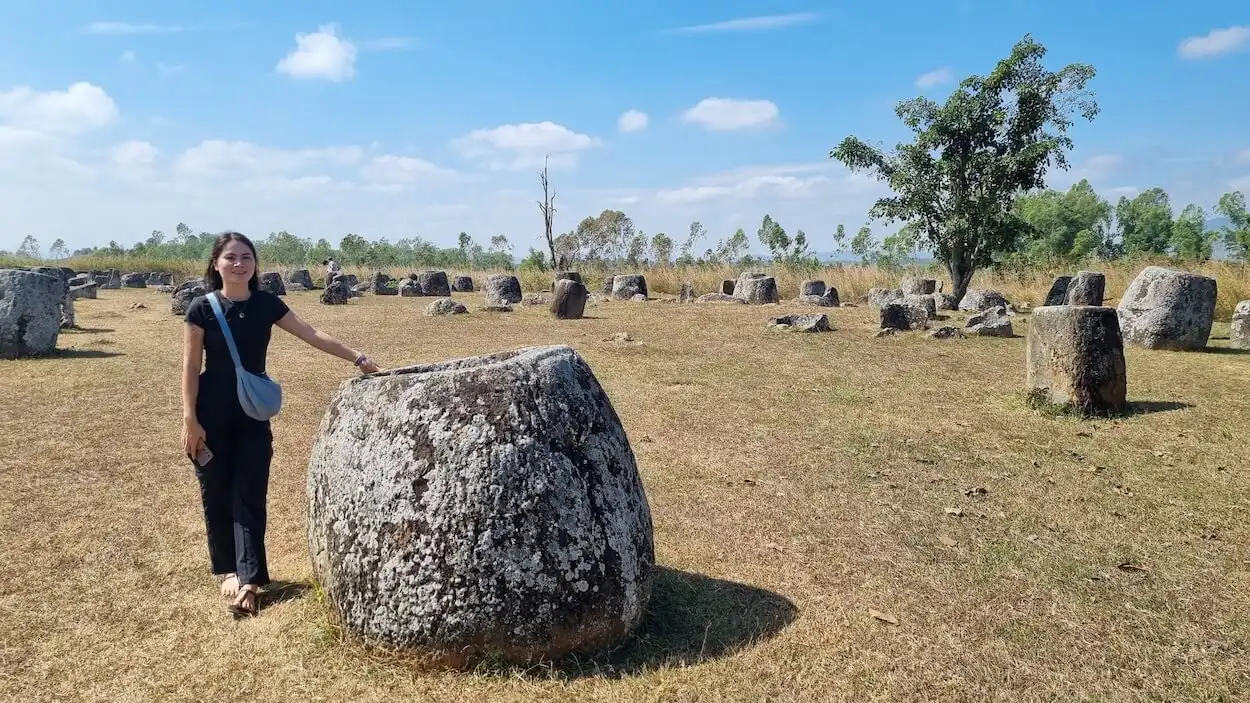
Site 2 feels quieter and a bit more scenic than Site 1. It is located on a hill in Phaxay District and is divided into three main jar groups. In total, the site has more than 90 jars, along with a number of stone discs and grave markers. Because of its elevated setting, Site 2 also offers a wider view over the surrounding landscape, which gives the place a very different atmosphere.
From an archaeological point of view, Site 2 is also important. Researchers did not find buried human remains here in the same way as at Site 1, but there is still strong evidence that the site was used for burial related practices. Excavations uncovered ceramic sherds, beads, bells, pendants, pottery, and other small objects connected to funerary activity.
Another interesting detail is that Site 2 and Site 3 share the same quarry source, which shows that the jars were part of a larger connected landscape rather than isolated sites. For visitors, Site 2 is a great addition if you want to see more than just the main site. It feels a little more peaceful, more open, and more atmospheric than Site 1.
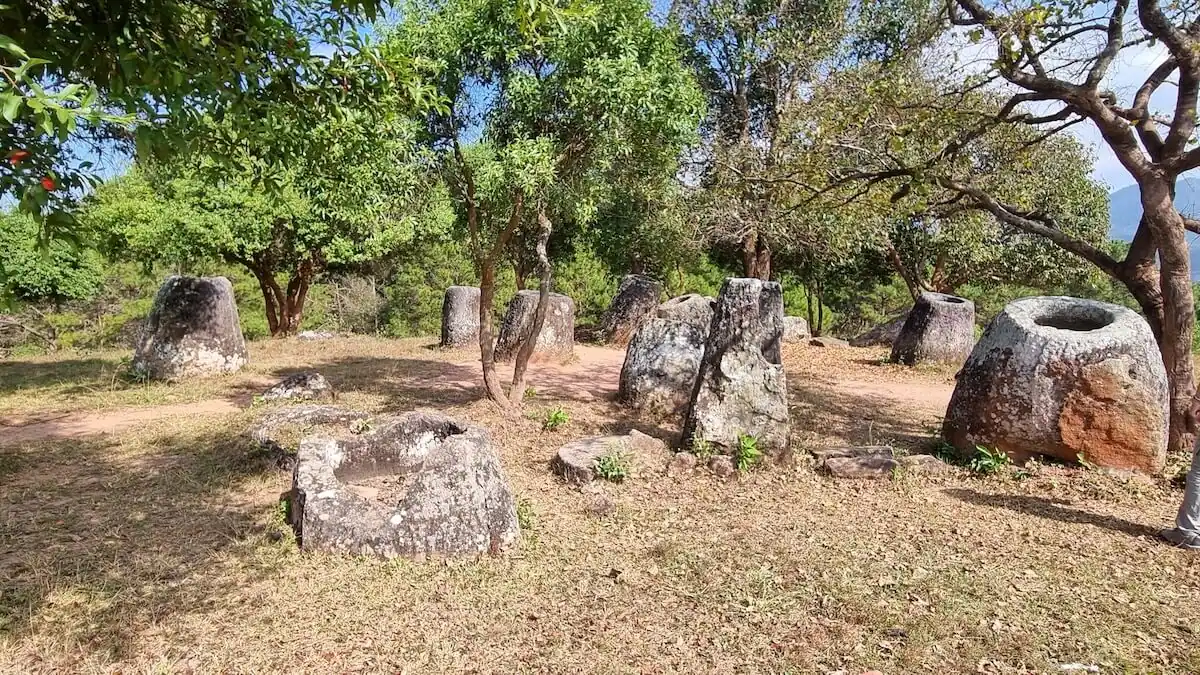
Site 3 is often described as the most scenic of the three main visitor sites. It is located near Ban Xieng Di in Phaxay District, around 5 km further south of Site 2, and is made up of seven groups of jars rather than one single cluster. The main group sits on top of a hill and looks out over the surrounding plain and rice fields, which gives the site a very open and peaceful feel.
Compared with Site 1, Site 3 feels less like the big headline attraction and more like a quieter extension of the wider Plain of Jars landscape. Official Laos tourism information notes that the main group has around 150 jars, and some of the jars here, like at Site 2, have an inner rim just below the lip. That detail shows again that the jar sites are connected, but still have their own small differences.
For visitors, Site 3 is a very good choice if you want more than just the most famous stop. It is usually combined with Site 2 and adds a more scenic and less crowded side to the experience. While Site 1 is the most important site from an archaeological and historical point of view, Site 3 stands out for its landscape, its hilltop setting, and the feeling of space around the jars.
Entrance fees need to be paid separately at each Plain of Jars site you visit. But entrance fees for attractions in Laos are generally very low and will not break anyone’s budget. Expect to pay around 30,000 to 40,000 LAK (about 1.40 to 1.80 USD) per site. Sometimes there is also a small parking fee, but that is usually no more than 5,000 LAK (around 0.23 USD). The Plain of Jars sites are usually open daily from 9 AM to 5 PM.
The history of the Plain of Jars is still not fully understood, and that is a big part of what makes the site so fascinating. What archaeologists do know is that the jars are ancient and belong to a much older cultural landscape than many travelers expect. UNESCO dates the main jar sites to roughly 500 BCE to 500 CE, with some evidence suggesting that parts of this tradition may have continued even later. The jars and the surrounding archaeological remains are considered some of the clearest evidence of an Iron Age civilization that once lived in this part of Laos.
For a long time, nobody knew what the jars were for. Early theories ranged from storage containers to vessels for collecting rainwater or fermenting rice wine. Today, archaeologists generally connect the Plain of Jars with burial practices. Excavations around the jars have uncovered human remains, burial pits, pottery, beads, iron and bronze objects, and other grave goods, which strongly suggests that the sites were used in connection with the dead rather than for simple storage (UNESCO, 2019).
Madeleine Colani was one of the first major researchers to study the Plain of Jars in the early twentieth century. Her work helped establish the idea that the jars were linked to burial practices, and later excavations supported that view. Today, researchers see the Plain of Jars as much more than just scattered stone containers. The wider landscape also includes stone discs, burial sites, quarries, and other funerary features, showing that this was a much larger ceremonial and burial landscape (Plain of Jars Archaeological Research Project).
Researchers also found that the jars were made from different types of stone, and some were transported from quarry areas to the sites where they still stand today. That would have required planning, labour, and considerable skill. Even now, many questions remain unanswered, which is why the Plain of Jars is still seen as one of the most important and most mysterious prehistoric sites in Southeast Asia.
A useful recent update from for the history section is that new research has strengthened the burial theory around the Plain of Jars. In a 2026 report, archaeologists described a large stone jar at Site 75, about 70 km northeast of Phonsavan, that contained the remains of at least 37 people. The bones were dated roughly from the 9th to the 13th centuries, and researchers think the jar may have served as a multigenerational burial place linked to ancestor rituals.
The find does not solve every mystery, but it is one of the clearest pieces of evidence so far that at least some jars were directly connected to funerary practices and that the wider Plain of Jars landscape likely functioned as a large ancient burial complex (Science News, May 2026).
The Plain of Jars is not only important because of its ancient history. It is also part of a region with a long and often violent past. The information panels at the Xieng Khouang Museum show that this plateau was once part of Muang Phuan, an important kingdom that controlled the Xieng Khouang plateau from around the mid fourteenth century. Because of its location, the region was linked to neighbouring powers and often became caught between stronger states such as Siam and Vietnam. Long before the twentieth century, Xieng Khouang had already seen political pressure, foreign influence, forced movement of people, and repeated instability (Information Panels, Xieng Khouang Museum, 2024).
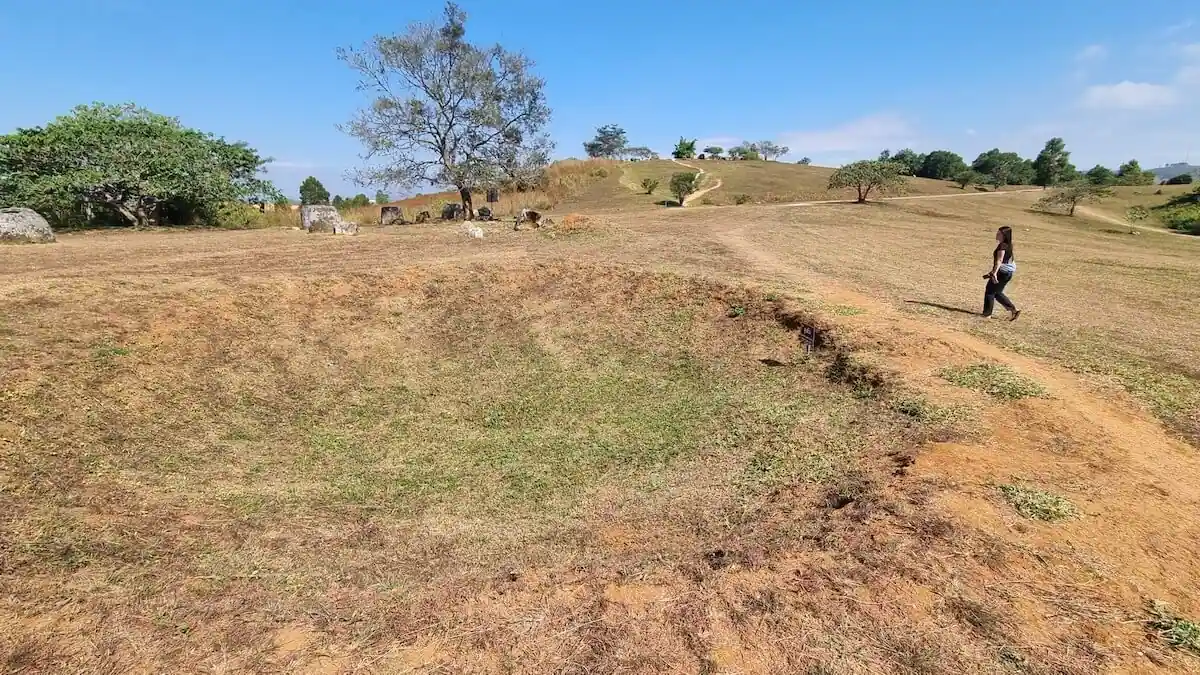
That pattern continued in the colonial period and after World War II. The museum information signs explain that after the French returned to Laos in 1946, Xieng Khouang again became strategically important during the struggle for independence and the First Indochina War. In the decades that followed, the region became even more important during the Laos Civil War and the wider Second Indochina War, also known as the Secret War in Laos. Xieng Khouang’s position on the plateau made it militarily valuable, and control of the province became key to the wider conflict (Information Panels, Xieng Khouang Museum, 2024).
This is why Xieng Khouang later turned into one of the most heavily war affected regions in Laos. Britannica notes that the Plain of Jars became a major battlefield in 1969 between North Vietnamese forces and the Royal Lao government and was subjected to heavy United States bombing. Legacies of War also states that by 1964, secret bombing sorties were already being flown over the Plain of Jars, while covert operations on the ground were expanding at the same time.
The war did not just pass through this landscape. It left permanent scars on it. Some jars were damaged or destroyed, and unexploded ordnance still affects the wider region today. MAG (Mining Advisory Group), which continues clearance work in Xieng Khouang, says that unexploded bombs still kill, injure, and hold back development in Laos more than fifty years after the bombing ended.
So when you walk through the site today, you are not just visiting a mysterious UNESCO World Heritage Site. You are also standing in a region that has seen kingdoms rise and fall, colonial conflict, civil war, secret bombing, and decades of recovery afterwards and until nowadays plenty of unexploded ordnance mostly because of the United States of America. That mix of ancient archaeology and modern history is one of the main reasons why the Plain of Jars feels so powerful in person.
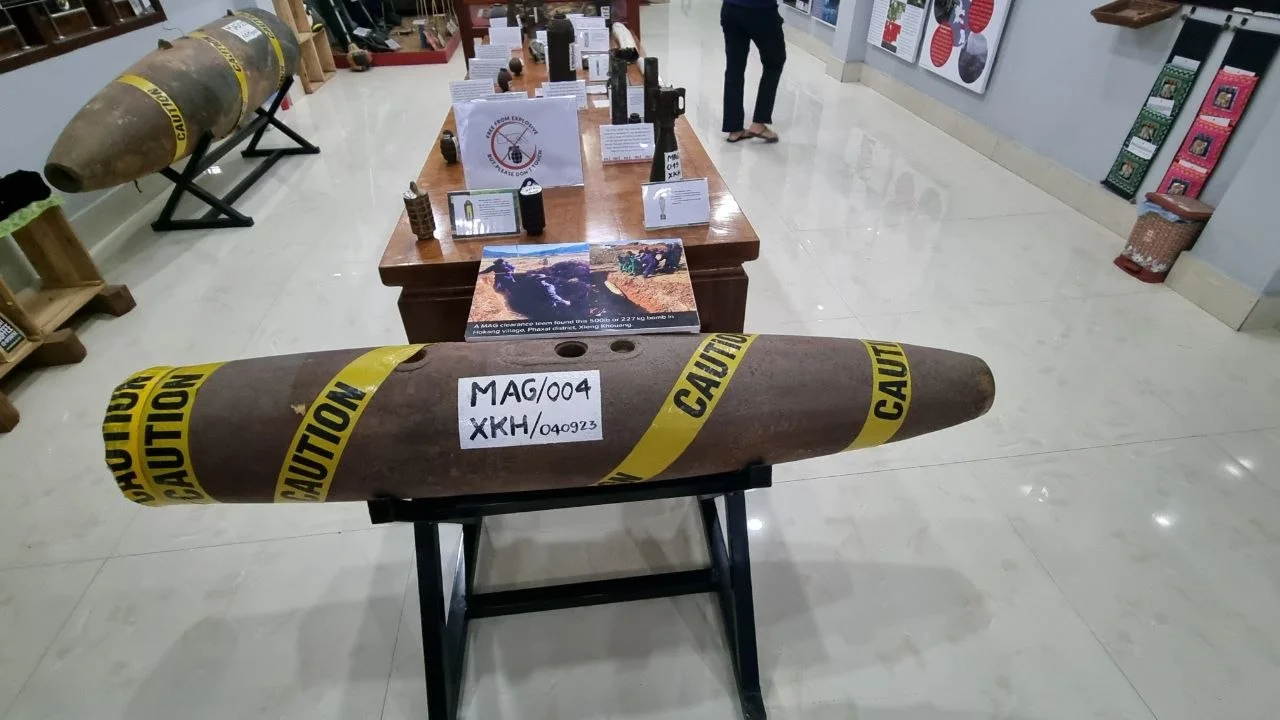
A general piece of advice when travelling in certain areas of Laos is simple: stay on the path! Even today, many UXO, meaning unexploded ordnance, are still left in the country. These dangerous leftovers of war times being cleared by organisations such as MAG, UXO Lao or Norwegian People’s Aid.
This is especially important in Xieng Khouang, one of the regions most heavily affected by bombing during the war. The main Plain of Jars sites are open and safe to visit, but visitors should always stay on the marked paths and never walk into fields or uncleared areas.
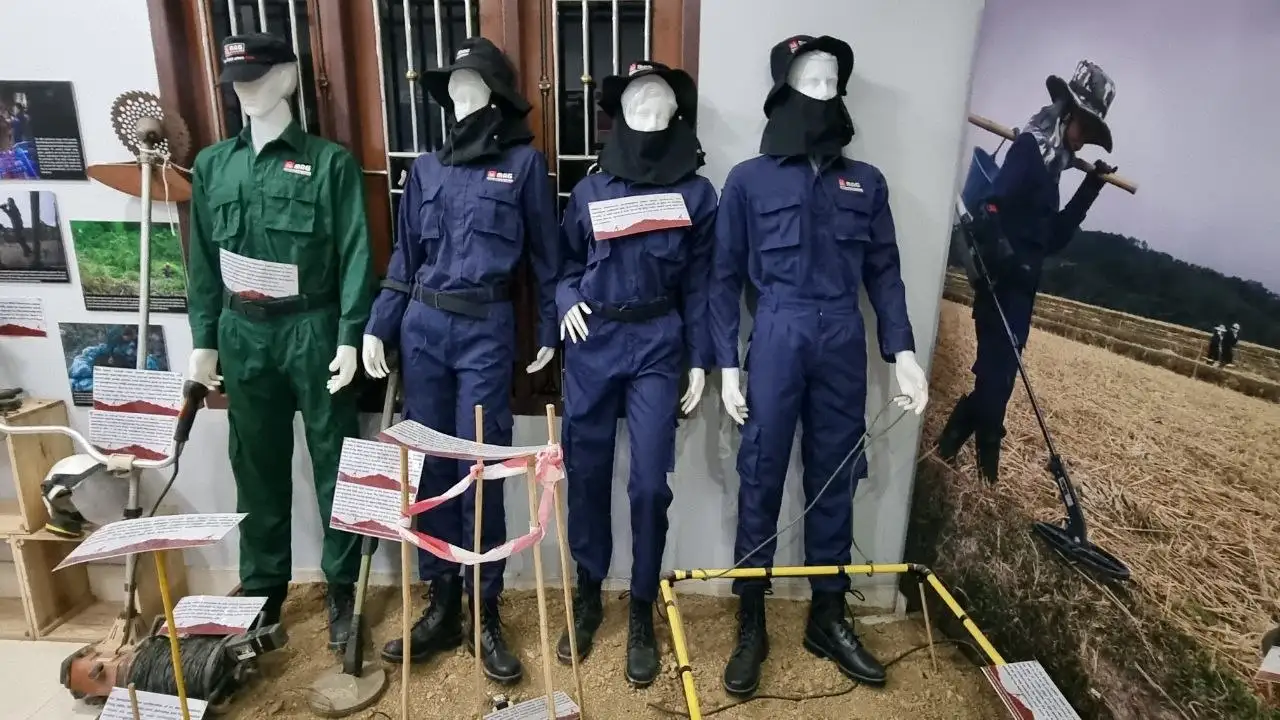
If you want to understand this part of Laos better, the MAG Visitor Centre in Phonsavan is worth a visit before or after the Plain of Jars.
Xieng Khouang is not only shaped by archaeology and war history, but also by a diverse culture that is still very visible today. According to Xieng Khouang tourism information, the province is home to a large Hmong population of about 44%, with Tai Phuan making up around 40% of the population. Other important ethnic groups in the province include Khmu and Tai Dam. This mix of communities is part of what gives Xieng Khouang its distinct identity today, from village life and local languages to clothing, food, traditions, and festivals. The biggest Hmong New Year Festival takes places every year around February in Xieng Khouang.
If you have more time in Phonsavan and Xieng Khouang, there are a few other worthwhile places to see besides the Plain of Jars.
➡️ Xieng Khouang Provincial Museum: Best place to learn about the history of the whole region.
➡️ MAG Visitor Center in Phonsavan: All details about the fascinating work of MAG. Heroes who clear UXO in Laos.
➡️ Muang Khoun: Once the center of the old Phuan Kingdom, still has a temple and some ruins to visit.
➡️ Ban Naphia: The village which is known for making spoons from war scrap.
Xieng Khouang is also one of the best places in Laos to experience Hmong New Year. The festival usually takes place between December and January and is one of the province’s most colourful cultural events. It brings together Hmong communities from across the region and even from overseas, which makes it a very special time to visit if you want to experience the living culture of Xieng Khouang, not just its history.
More things to do in Xieng Khouang can be found on the official Tourism Website.
➡️ Kong Keo Guesthouse, Tours & Motorbike Rentals:
For under 17 USD, you get a clean private room in a local guesthouse, which is very close to the center. Many things like the MAG visitors center and plenty of restaurants are in walking distance. You can also book tours and rent motorbikes with the owners. Nice local lao family. They also have dorm beds available. Check Prices & Book it here
➡️ Sipanya Guesthouse:
Just a bit more hidden in a quiet neighborhood, Sipanya guesthouse is available for around 22 USD per room / night. The rooms are quite new, modern and very clean. Strong WiFi available. Friendly and english speaking staff at the reception, hot water and good water pressure. Also in walking distance to many nearby places and restaurants. Check Prices & Book it here
➡️ Vansana Plain of Jars Hotel Phonsavan: It’s a bit out of town, but still central enough for those who have some transportation. The hotel is located on a hill, which give you great views over the surrounding area. Prices are a bit higher. Expect to pay around 35 USD for a room. Check Prices & Book it here
The Plain of Jars is one of the most fascinating and mysterious places in Laos. Located in Xieng Khouang Province near Phonsavan, it consists of thousands of ancient stone jars spread across a wider highland landscape.
Archaeologists believe the sites date back to the Iron Age and were linked to burial practices, but many questions about their exact purpose and the people who created them remain unanswered. Today, the Plain of Jars is a UNESCO World Heritage Site and one of the most important archaeological landscapes in Southeast Asia. At the same time, the region also carries the scars of the Secret War in Laos, which gives the site an added layer of historical depth.
❓Would Laos Insider recommend the Detour of getting there? Absolutely yes, if you are interested in mysterious places and history.
The Plain of Jars is an ancient archaeological landscape in Xieng Khouang Province in northern Laos. It consists of thousands of large stone jars spread across different sites near Phonsavan and is one of the country’s most important historical landmarks.
Archaeologists believe the main jar sites date roughly from 500 BCE to 500 CE. This places them in the Iron Age, although some burial activity at the sites may have continued later.
Most travelers visit Site 1, Site 2, and Site 3, which are the main visitor sites near Phonsavan. However, the wider Plain of Jars landscape includes many more archaeological sites across Xieng Khouang Province.
If you only want to see Site 1, a full day is enough. If you want to visit Site 1, Site 2, and Site 3 in a more relaxed way, it is better to allow another half-day.
Yes, especially if you are interested in archaeology, history, and places that feel different from the usual Laos travel route. The Plain of Jars is one of the most unique and historically layered destinations in the country.
Disclosure: This article contains affiliate links. If you make a purchase through them, we may earn a small commission and you support our blog to write more helpful articles – at no extra cost to you.