
Disclosure: This article contains affiliate links. If you make a purchase through them, we may earn a small commission and you support our blog to write more helpful articles – at no extra cost to you.

Without any doubt, every traveler who has been to Southeast Asia has definitely heard of, or even been to the famous Khmer temple complex of Angkor Wat in neighboring Cambodia. But hardly anyone has probably heard of Vat Phou (sometimes referred to as Wat Phou) in the southern Lao province of Champasak.
Nestled at the foot of Phou Kao (simply translating to Mountain in Lao) and overlooking the Mekong River, Vat Phou is one of Laos’ most impressive yet underrated historical sites. This ancient temple complex dates back more than a thousand years and offers a fascinating glimpse into the early Khmer civilization that once extended deep into present-day Laos.
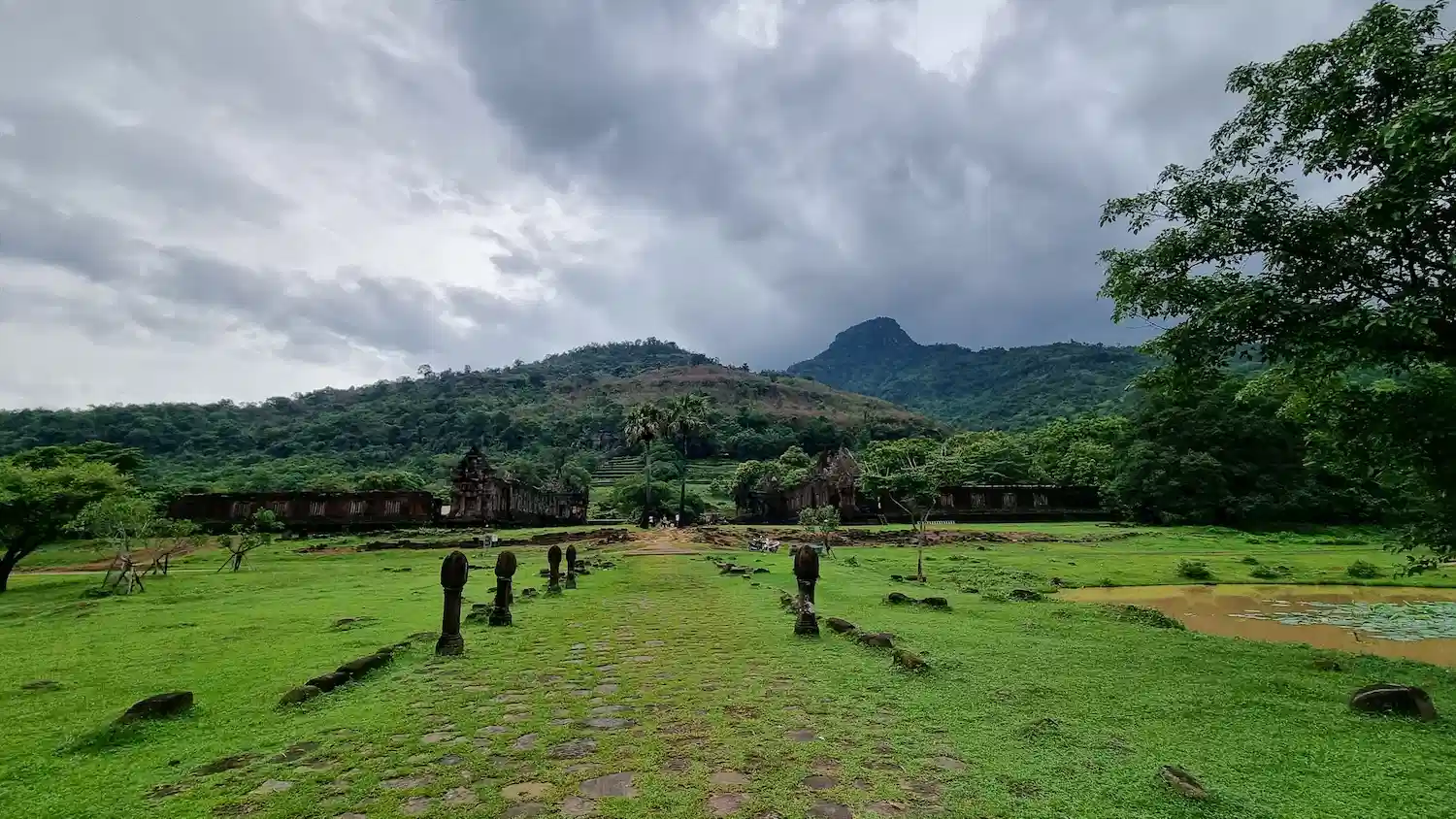
Unlike the (over)crowded corridors of Angkor, Vat Phou remains calm and spiritual. A place where history, nature and faith quietly coexist. The ruins are scattered across terraced hillsides, connected by ancient stone causeways and framed by lush greenery (during and after rainy season). Walking here feels more like a journey through time than a typical tourist attraction. For those who take the time to travel south from Pakse or the 4,000 Islands (Si Phan Done), Vat Phou rewards its visitors with breathtaking views and full of history.
Most Tourists visit to the southern Region of Laos mainly for doing the Bolaven Plateau Loop before continuing their journey either further south for entering Cambodia or further North towards Savannakhet, Thakhek or Vientiane, depends from which direction they are coming from. Vat Phou is often skipped, even though it’s just around 40 km south from the city of Pakse, which makes it an easy half day trip. Find out everything you need to know about visiting Vat Phou – a gem in Southern Laos.
The name Vat Phou (ວັດພູ) literally translates to “Temple on the Mountain.” In Lao language, “vat” means temple and “phou” simply means mountain, a fitting name for this sacred site located at the base of Phou Kao Mountain in Champasak Province.
The mountain has been seen as a holy place for hundreds of years. The shape looks like a giant lingam — a symbol of the Hindu god Shiva and people believed it has powerful energy. Long before the temple was built, the mountain was already a sacred place for local people who practiced animism and later Hinduism.
Over time, Vat Phou became a center for Buddhist worship, especially in the Theravada tradition. Old beliefs and new ones slowly mixed together, creating a unique spiritual atmosphere that still shapes local Lao culture today. Even now, many locals come to Vat Phou to make offerings, light incense or simply sit quietly to pray. It’s not just an ancient ruin, it’s a living temple that still connects the people of southern Laos to their faith and history.
Vat Phou was added to the UNESCO World Heritage list in 2001 because of its great historical and cultural value and connections to the significant Khmer Empire in the region. The site includes not only the main temple but also ancient roads, ponds, and small villages that were once part of the huge Khmer Empire. It shows how early builders designed their temples to fit perfectly into the natural landscape. UNESCO protects Vat Phou today as one of the best examples of how nature, religion, and architecture can exist in harmony.
The history of Vat Phou goes back more than 1.000 years. The first temple on this site was built around the 5th century, which is actually long before the famous temples of Angkor in Cambodia were built. At that time, the area of Champasak was part of the Khmer Empire, and Vat Phou became one of its most important religious centers.
The Khmer Empire covered a big part of mainland Southeast Asia, including what is now Cambodia, Laos, Thailand, and parts of Vietnam. Many of the ancient temples found in eastern and northeastern Thailand today were also built during this time, following the same Khmer style as Vat Phou and Angkor Wat.
Some of these temples, like Preah Vihear, have even caused border disputes between Cambodia and Thailand, since their architecture and carvings clearly show Khmer, not Thai, origins. After Cambodia’s independence, Thailand occupied the 900-year-old Preah Vihear temple, leading to decades of border tension. The International Court of Justice later ruled that the temple and its surrounding area belong to Cambodia, confirming its status as a Khmer heritage site. Thailand however, still has problems with accepting this decision from the neutral ICJ.
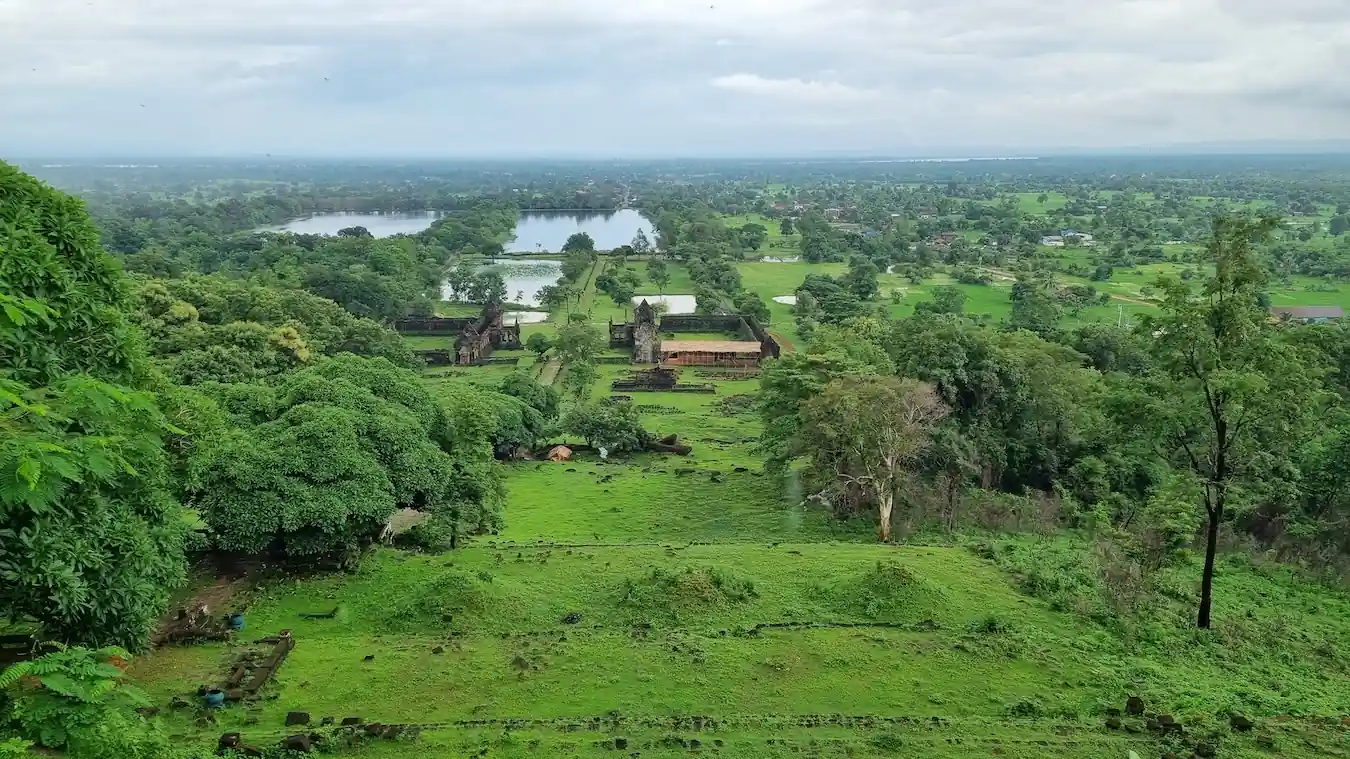
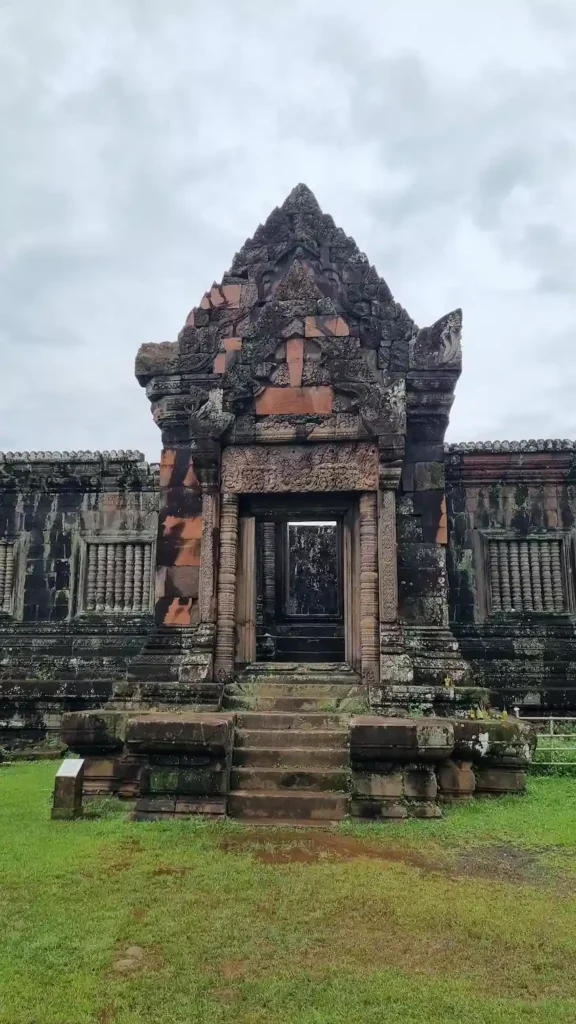
The Vat Phou temple complex is spread across several terraces climbing gently up the side of Phou Kao Mountain. Visitors enter through a long stone causeway lined with ancient pillars before reaching the lower and upper levels, where ruined galleries and shrines stand among frangipani trees. At the top sits the main sanctuary with a small spring that still flows from the mountain and is considered holy by locals. Along the way, you’ll spot weathered carvings, statues, and peaceful corners perfect for quiet reflection. The climb ends with a stunning view over the Mekong plains — a reward that makes the walk well worth it.
The temple complex can be easily explored on your own by foot. Because the area is a bit spread out and starting point is far from the entrance, there is a free shuttle service bringing visitors to the temple grounds (included in ticket price). Whoever prefers to walk from the entrance, can do so. It’s a 15-20 minutes walk next to the lake with nice views. For those interested in details about the temples, can contact a tour agency in Pakse for guided tours or ask at the entrance of Vat Phou. Keep in mind, that booking guided tours on site might not be always available. A combined tour with two of the most famous waterfalls Tad Fane and Tad Yuang + Vat Phou temple can be pre-booked online here.
Vat Phou was first built to honor Shiva, the Hindu god of creation and destruction. The mountain behind the temple was seen as holy because its shape looks like a giant lingam, which is the symbol of Shiva. Later, between the 10th and 13th centuries, more terraces and stone buildings were added in the beautiful Khmer style, with long stairways and detailed carvings all around the temple complex.
As time passed, Hinduism slowly disappeared from this part of Laos and Theravada Buddhism became the main religion. Instead of leaving the old temple behind, local people simply changed it. The Hindu carvings were kept, new Buddha statues and small shrines were added.
Today, Vat Phou shows a peaceful mix of both faiths. Ancient Hindu symbols standing beside Buddhist altars. It’s a good example of how Lao culture respects different beliefs and how religion in this region has changed over time.
Going to Vat Phou is quite straight forward and not difficult to travel to. Depending from which direction you’re coming from, either from Pakse, the 4000 Islands or somewhere else – there are many options of getting there without any hassle.
The roads are mostly paved and well-maintained, and signs for Champasak and Vat Phou are easy to follow. Whether you go by scooter, private car, or local transport, the journey is smooth and gives you a nice glimpse of rural southern Laos.
Every traveler going through southern Laos, will at some point stop in the city of Pakse. It is the travel hub and biggest city in the southern region of Laos. Therefore plenty of transport options are available. From Pakse it is just a bit over 40 km to reach Vat Phou. The road conditions are good. It is a paved road with some potholes, but nothing impossible. Quite an easy ride on a flat road. By car it takes 45-60 minutes to reach Vat Phou coming from Pakse.
Renting a scooter in Pakse is the most popular and flexible way to visit Vat Phou. Daily rentals usually cost between 150.000 – 200.000 LAK (about 7–9 USD). From Pakse, follow Route 13 south until you see signs for Champasak / Vat Phou. You can cross the Mekong via the ferry at Ban Muang to Pha Pin, which adds a fun local touch to the journey. The ferry runs all day and costs only a few thousand kip for a bike and driver. Otherwise just follow Google Maps from Pakse until you reach Vat Phou.
If you prefer not to drive, you can hire a private car or tuk-tuk from Pakse. The round-trip price ranges from 300,000 to 650,000 LAK (15–30 USD), depending on your negotiation skills and whether you stop in Champasak Town for lunch or coffee. Shared songthaews (local pickup trucks with benches) also run between Pakse and the ferry point at Ban Muang but can be slower and less comfortable, but usually much cheaper because mostly locals travel with them. Just flag them down on the road or ask your hotel/guesthouse how to jump in one of them.
If you’re traveling from the 4,000 Islands (Si Phan Don), you can visit Vat Phou on your way north to Pakse, it is not a detour and perfectly located on your route to Pakse. Take a morning boat from Don Det or Don Khon to Nakasang, then catch a minivan or local bus toward Pakse. Ask the driver to drop you at the Champasak turn-off or Ban Muang ferry. From there, you can cross the river and hire a motorbike or tuk-tuk for the short ride to Vat Phou.
From Don Det to Champasak Town expect around 4-5 hours of travel time by minivan and local ferry. This journey will set you back roundabout 200.000 LAK each, which is super cheap. If you continue later to Pakse, just take the public bus from Champasak to Pakse. This journey shouldn’t cost you more than 70.000 – 100.000 LAK.
I still see so many blogs writing about Laos and unfortunately still recommending services like "12Go Asia". This platform is useless and overpriced in Laos. Do yourself a favor and don't use 12Go Asia in Laos. In Laos, most transport options aren’t listed online and prices shown on 12Go Asia are often much higher than what you’d pay locally. It’s far easier and cheaper to book directly at the bus station or through your guesthouse. Locals are friendly and helpful, and you’ll often find more departure times and better prices than anything advertised online.
Everything you need to know before visiting Vat Phou. Because Vat Phou is a temple, which is still used by locals for making merit and other buddhist traditions, it’s important to know some things like dresscode and behaviour on the ground. Also opening hours, best time to visit and entrance fees.



If you are visiting Vat Phou in Champasak around February, you might be lucky to attend the yearly Vat Phou Festival. Every year in February during the full moon, the quiet temple grounds of Vat Phou transform into a lively celebration known as the Boun Vat Phou Festival. It’s one of the biggest cultural and religious events in southern Laos, where thousands of locals and monks gather to pay respect, make offerings, and celebrate their beliefs.
The festival combines traditional Buddhist ceremonies with local music, dance performances, food stalls, and markets. Pilgrims light candles and walk up the ancient terraces at night, creating a magical atmosphere around the centuries-old ruins. It’s a rare chance to see Vat Phou not just as an ancient monument, but as a living spiritual center that still connects people to their roots.
Your experience of Vat Phou might differ from the time of the year you visit. The former hindu temple complex is open all year round and can be visited anytime during the opening hours. However, I personally find rainy season or just after the green season as the best time of the year to stop at Vat Phou. Rainy season transforms the whole country in a lush & green paradise.
Vat Phou sits on a small hill, where the views are great over the whole area. When everything is nice and green views are clear only with some occasional, but impressive clouds. Deep into dry season around march-may the whole region looks much drier. In case someone would ask me what the best months are to visit Vat Phou, I would say from September – December, when the landscapes are still not too dry and weather gets cooler.
Pakse is the lively gateway to southern Laos with a mix of riverside views, local markets, and the starting point for adventures to the Bolaven Plateau Loop and Vat Phou in Champasak. It’s a relaxed town with a local charm rather than a big tourist scene, making it perfect for travelers who prefer authenticity over nightlife. Just a short drive south lies Champasak Town, a peaceful riverside village with colonial-style houses, cozy guesthouses and Mekong River views. Whether you’re looking for a comfortable hotel in Pakse, a quiet bungalow by the river in Champasak, or something in between, the area offers plenty of affordable options. Here are some recommended places to stay in Pakse and Champasak.
👉 Pakse Hotel & Restaurant: Convenient Location right in the center of Pakse. It’s an old fashioned hotel, but very clean. Staff is friendly and prices are fair, not expensive. There is a nice rooftop restaurant on top of the Hotel with great food and nice views over the city. Room prices range between 25-35 USD for double rooms.
Medium-budget option
👉 Athena Hotel: Also at a convenient location in Pakse town, this hotel is a bit more of a luxurious choice. Prices ranging between 40 – 55 USD still make it a great deal for what you get. They have a big and clean swimming pool, lovely garden, terraces and offer a good selection of food. Also the breakfast is delicious there. Stylish & modern choice – recommended. Higher-budget option
👉 Pakse Backpacker Hostel 2023: This is one of the cheaper choices in Pakse. A classic hostel with different dormitories. Prices are super cheap, starting at around 6-7 USD per person. Its clean and location is central. For Backpackers looking cheap options, can’t go wrong with this hostel.
Cheap-budget option
👉 Nakorn River View: Perfectly located on the Mekong in Muang Champasak. This medium-priced hotel is nice option with good service, great food and friendly staff. The sunset views are hard to beat. Prices ranging around 40+ USD per night, can be lower in off-season. There is even an electric charger for electric vehicles on site.
Medium-budget option
👉 Residence Bassac: Thats the hotel of your choice if you are looking for some upperclass feeling. A french colonial style building with high hotel standards and super friendly service. With prices roundabout 70-90 USD, this hotel is something for those who want to spend a bit more on luxury, but still affordable for what you get.
Higher-budget option
👉 Khamphouy Guest House: A typical and simple lao-style guesthouse located on the Mekong. Compared to other hotels in Champasak, this one is one of the cheapest options with prices around 10+ USD. A very convenient stop for a night or two for people want to visit Vat Phou. Local owners, friendly as always – highly recommended for cheap & clean, local stay.
Cheap-budget option
Vat Phou is more than just ancient ruins, it’s a place where the past and present of Laos meet. Surrounded by green hills and the slow-moving Mekong, this quiet temple complex tells stories of the Khmer Empire, ancient beliefs, and the deep spirituality of the Lao people. Whether you come for history, photography, or simply to feel the peaceful atmosphere, Vat Phou will leave a lasting impression. It’s an easy trip from Pakse, yet it feels far away from modern life. For anyone exploring southern Laos, a visit to Vat Phou is a must — a journey into history, culture, and the timeless heart of the Lao spirit.